from HellsBelle@sh.itjust.works to world@lemmy.world on 17 Feb 2026 22:36
https://sh.itjust.works/post/55495954
The winner of the Goncourt, as the prize is called, is likely to enter the pantheon of world literature, joining a lineage of writers that includes Marcel Proust and Simone de Beauvoir. The prize is also a financial boon for authors. As the biggest award in French literature, the Goncourt means a prime spot in storefronts, foreign rights, prestige. By one estimate, winning the Goncourt means nearly €1m of sales in the weeks that follow.
In November 2024, the Académie Goncourt gave the prize to a novel by Kamel Daoud, a celebrated Algerian writer living in France. His victory came at a tense moment for France and its former colony. The relationship, never an easy one, had been strained by the Algerian state’s increasing political repression of its people and French involvement in the dispute between Algeria and Morocco over Western Sahara. (France has sided with Morocco, which claims sovereignty over the territory; Algeria has supported independence movements there.)
Houris, which was not published in Algeria, tells the story of the war through a 26-year-old woman, Fajr or Aube (Dawn), who, as a child, survived a massacre at Had Chekala, a village where a real massacre took place in January 1998. In the novel, terrorists killed Aube’s family and cut her throat with a knife. The attack gave her a large scar across her neck: her “smile”, as she calls it. To breathe, Aube has undergone a tracheostomy, a procedure through which the neck is opened to access the windpipe. She wears a cannula, which she sometimes hides with a scarf. “I always choose a rare and expensive fabric,” she says. But the injuries from the attack mean that, two decades on, her voice is barely audible. For her, the scar is a sign of a history that many want to forget. “I am the true trace, the most solid of signs of everything we lived through for 10 years in Algeria,” she says.
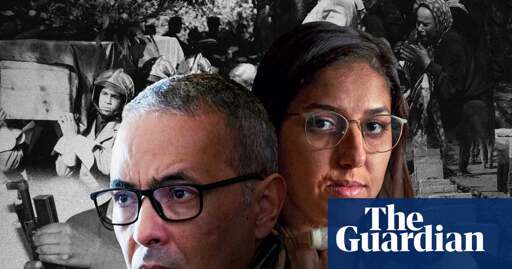
Eleven days after the Goncourt ceremony, a woman appeared on an Algerian news show. She wore a blue-and-white-striped shirt; her long hair was tied into a bun. This left her neck visible, and attached to it, some breathing apparatus with a cannula. She introduced herself as Saâda Arbane, 30. Daoud, she claimed, had stolen her personal details to make his bestseller. “It’s my personal life, it’s my story. I’m the only one who should determine how it should be made public.” For 25 years, she said, “I’ve hidden my story, I’ve hidden my face. I don’t want people pointing at me.” But, Arbane said, she had confided in her psychiatrist. “I had no filter, no taboos. I told her everything.” Her psychiatrist was Kamel Daoud’s wife.
#world
threaded - newest
Nothing about this on wikipedia. I wonder if its been washed or something else?
Because you're looking at the English Wikipedia? It's there in the French Wikipedia.
I’m not french. Also your link isn’t to his wiki.
This is a definition of houris or something. I don’t read french.
fr.wikipedia.org/wiki/Houris/_/(roman/)
Also when I looked him up on the french version and translated there was no mention of him and his wifes actions.
Kamel Daoud is an Algerian doctor, vice-president of the Algerian League for the Defense of Human Rights (LADDH) since 2004, in charge of external relations, representative of the wilaya of Algiers. He is also the president of the Parisian association Association Algérie-Droits de l’Homme pour tous. Biography This section is empty, insufficiently detailed or incomplete. Your help is welcome! How to do it? He was for a time acting secretary general of the Front of Socialist Forces. During the 2007 struggle for control of the LADDH, he supported Mustapha Bouchachi as president against Hocine Zehouane. In 2008, he intervened several times on the phenomenon of harragas. During the Algerian protests of 2011, he repeatedly criticized the LADDH’s approach to participation in the Coordination for Change and Democracy, considering it inappropriate and subservient to the Rally for Culture and Democracy.
fr.wikipedia.org/wiki/Kamel_Daoud_(militant)
Maybe if you were to make just a little more effort and consider that a ‘militant’ is not an ‘écrivain’ you would have found it.
Or just not be a fucking annoying American and be too lazy to have learned another language while making confident statements about information in that language.
I typed in his name and found it just fine.
Probably no one has bothered to add it, most likely because it’s relatively minor news, and also rather recent and just allegations.
You can be the person to write it up if you want. That’s how Wikipedia works.
What are you? His PR team.
Wikipedia has quite a few processes to ensure everything is factual
Unless this is proven, it’s just an allegation. Not saying she is absolutely lying but any person with similar injuries, having lived in that village, could make that claim.
Until something like this is proven, and if it won’t become any bigger news, it probably won’t be added to the page
You’re allowed to add allegations to wikipedia, so long as they are flagged as allegations and properly cited.
Sounds like a great book. Has anyone read it?
Sounds like a psychiatrist should be banned from praticing and a price withdrawn