from HellsBelle@sh.itjust.works to world@lemmy.world on 15 Apr 16:17
https://sh.itjust.works/post/58572058
The world’s top 100 oil and gas companies banked more than $30m every hour in unearned profit in the first month of the US-Israeli war in Iran, according to exclusive analysis for the Guardian. Saudi Aramco, Gazprom and ExxonMobil are among the biggest beneficiaries of the bonanza, meaning key opponents of climate action continue to prosper.
The conflict pushed the price of oil to an average of $100 (£74) a barrel in March, leading to estimated windfall war profits for the month of $23bn for the companies. Oil and gas supplies will take months to return to pre-war levels and the companies will make $234bn by the end of the year if the oil price continues to average $100. The analysis uses data from a leading intelligence provider, Rystad Energy, analysed by Global Witness.
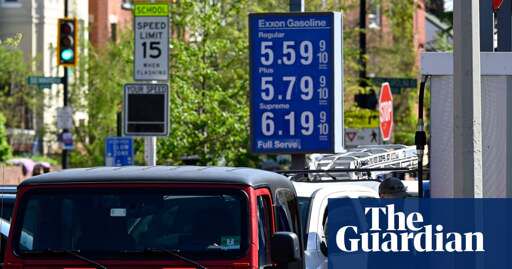
The excess profits come from the pockets of ordinary people as they pay high prices to fill up their vehicles and power their homes, as well as from businesses incurring higher energy bills. Dozens of countries have cut fuel taxes to help struggling consumers, meaning those nations, including Australia, South Africa, Italy, Brazil and Zambia, are raising less money for public services.
Pressure is growing for windfall taxes on the war profits of oil and gas companies, with the European Commission considering a request from the finance ministers of Germany, Spain, Italy, Portugal and Austria to “send a clear message that those who profit from the consequences of war must do their part to ease the burden on the general public”.
#world
threaded - newest
Spot price of oil goes up, domestic producers get richer.
On the flip side, we’re also seeing a surge in mass transit use and big cuts in the number of flights planed for the rest of the year. Wouldn’t be surprised if there was a blitz of new alt-energy construction and surge in sales of EVs in the next few years, either. Not unlike after the Bush-Era $6/gal gas spike during the Iraq War.
Trump’s crusade for $500/bbl gas is doing more to de-carbonize the economy than anything Biden or Obama tried.
Has this ever actually been implemented? I see “windfall taxes” legislation floated every couple of years, when price gouging goes to 11. I never see anyone ballsy enough to implement it.
Rarely and never high enough to check price gouging.
How does this work. If oil costs more doesn’t that also increase the expenses for gas companies? Are they just exponentially raising prices?
Because oil prices fluctuate with the market … so prices rose on oil that had been produced at the cheaper rates but sold at much higher values.
Okay I was thinking this too. They have a stock already.
Oil companies always pass on the extra cost to their clients. Usually they keep the same profit margin, so in the end they make more when it gets more expensive. Until the international prices drop, or when demand slows down (pandemic, serious economic crisis). It’s why energy companies like fossil fuels more, because they can pass on the cost. Renewable energy is mostly a fixed upfront cost.
This is an overly simplified view and missing a lot of complexities, but think of it this way:
The cost to bring something to market is passed to the consumer plus a percentage the Company adds for their profit margin.
Item costs $1.00 to bring to market + 10% for corporate profits = retail price of $1.10 of which the Company makes $0.10.
An increase of item costs to $1.20 to bring to market + the same 10% for corporate profits = retail price of $1.32 of which the Company makes $0.12 for the same thing.
They make more money while passing the go-to-market increase onto you.
I see. Thanks!