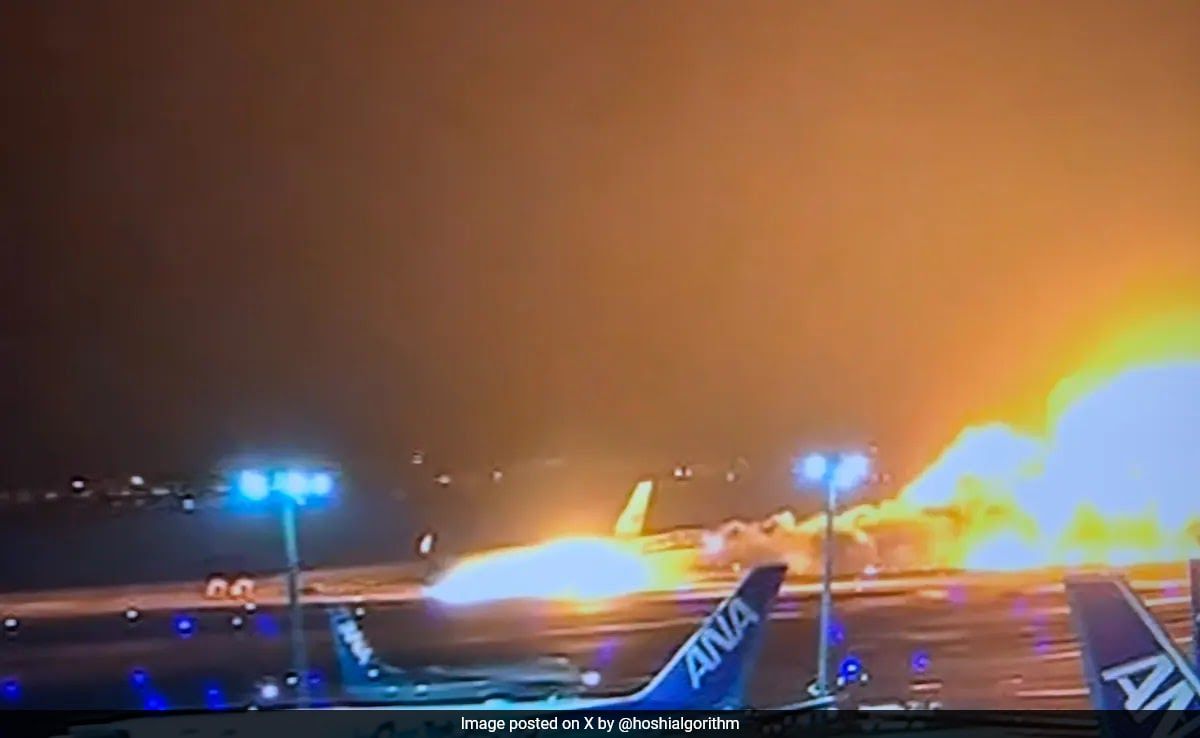
Video: Plane In Flames At Tokyo Airport After Collision, Over 350 Evacuated
(www.ndtv.com)
from return2ozma@lemmy.world to world@lemmy.world on 02 Jan 2024 09:51
https://lemmy.world/post/10228583
from return2ozma@lemmy.world to world@lemmy.world on 02 Jan 2024 09:51
https://lemmy.world/post/10228583
#world
threaded - newest
Ouufff, Japan is having a rough time recently.
The coast guard was going up to Niigata with disaster relief. Without the earthquake, no plane collision :/
damn, it feels like the end of the world is coming
lol what?
Because of a plane crash? Over-dramatic much?
Last edited Jan 4, 12:25 UTC
Japan Airlines flight 516 (JAL516, registration JA13XJ) Airbus A350-900 from Sapporo to Tokyo’s Haneda Airport collided while landing with a coast guard aircraft JA722A De Havilland Canada DHC-8-315Q MPA “Dash-8” that belonged to Haneda Air Base, which was awaiting departure to Niigata with aid following the New Year’s Day Earthquake.
All 367 passengers (including 8 children) and 12 crew members safely evacuated JAL516 after it stopped in the grass adjacent runway 34R. [1] Japan Airlines SVP Noriyuki Aoki clarified in a press statement that of the 14 injuries, “only four” passengers went to hospital for “feeling unwell,” of which two for smoke inhalation. [2] The aircraft’s nose gear collapsed and engines and wings were engulfed in flames immediately following the collision.
Of the six crew members on board JA722A, 5 crew members died in the collision or resulting fire, according to Japan’s transport minister Tetsuo Saito. Public broadcaster NHK said the plane’s captain was in a critical condition. [1]
The immediate seconds following the collision show both the Airbus (left) and Dash-8 (right) in flames:
<img alt="" src="https://lemmy.world/pictrs/image/80a073c9-a0d9-414a-b7da-9bc42735b085.jpeg">
Further insights
These are the aircraft involved:
<img alt="" src="https://lemmy.world/pictrs/image/83d826b2-39d4-4209-8e87-f2a531c253c2.jpeg"> <img alt="" src="https://lemmy.world/pictrs/image/e0920de4-71dc-4e09-8a46-32a4b6df47ef.png">
Airbus has issued a statement that a team of Airbus investigators are joining the French BEA, British AAIB and Japanese JTSB. [3]
Japan’s Ministry of Transport said on Jan 3rd that JA722A had received instructions to “proceed to a holding point on a taxiway to the runway,” [4] noting that the coast guard captain by his own testimony however understood this instruction as takeoff clearance [5], subsequently lining up on runway 34R and setting the stage for the collision. The JTSB is investigating the occurrence.
Tokyo’s Metropolitan Police reported they have opened an investigation for professional negligence into the accident.
The JTSB has recovered the voice recorder from the coast guard aircraft. [3]
Minutes after evacuation of JAL516, which completed 18 minutes after touching down [10], the cabin flashed over and the aircraft was reduced to just the engines, wings and parts of the tailplane and nose cone. Daybreak revealed the devastation of the inferno, despite the extinguishing efforts of more than 100 fire engines [2]:
<img alt="" src="https://lemmy.world/pictrs/image/d88ad7ba-3908-41da-a007-daa2a86cb1d2.webp">
A compounding factor is that the right hand number 2 engine was unable to be shut down and continued to run during the evacuation of the passengers [6], and a video recording shows it spraying sparks that inhibited the use of the rear starboard escape slide.
Videos and photos suggest that of the eight exits, only three slides were used in the evacuation (rear port side and both front exits):
<img alt="" src="https://lemmy.world/pictrs/image/2fa2987c-edc8-4dd1-86fb-02243ec780db.jpeg"> <img alt="" src="https://lemmy.world/pictrs/image/27e2a9b3-5fce-4bc3-989e-4722e4bd8cd2.jpeg">
Smoke was present in the cabin during evacuation (longer video) and one passenger stated in an interview that it smelled of “burning chemicals.” [2]
This marks the first hull loss of an A350. JAL516 was newly delivered to Japan Airlines in November 2021.
The Dash-8 involved, JA722A, also called under its alternative registration, MA722 “Mizunagi,” and was pil
Thank you for the details and outstanding explanation and sources.
Aircraft positioning
The aforementioned Live Cam video provides evidence that JA722A entered onto runway 34R at intersection C-5 and remained stationary until the impact. As a visual reference, other aircraft DAL276 and JAL545 are seen further to the right, queueing up to intersection C-1. The moment of impact is also captured in a passenger video from on board an aircraft taxiing past C-5.
Previous discussion that JA722A would have entered at C-1 can be eliminated for the stated reasons, but also noting that this intersection is too short of the touchdown zone of runway 34R, and this video (at 1:48) appears to show the burning collision site as seen from a plane that was holding short at C-1 of 34R. Here, too it is clear that there is some distance, about 3 taxiways between the camera and the fire, confirming that the collision must have occurred near to C-5. The Approach Lighting System (ALS) provides visual reference for runway 34R. Despite its name, standard operating procedure is that ALS is used both during takeoffs and landings.
In the press conference held by the Civil Aviation Bureau of the Ministry of Land, Infrastructure, Transport and Tourism and the Japan Coast Guard, where a collision diagram was shown to reporters [2]:
<img alt="" src="https://lemmy.world/pictrs/image/f244345b-ee93-44e6-a05b-529790b51345.jpeg">
Here I’ve recreated that illustration that labels both intersections C-1 and C-5 on the updated 2022 RTJJ/HND airport chart:
<img alt="" src="https://lemmy.world/pictrs/image/21f35a91-3de3-45b9-9df1-fb79a25bbf12.png">
JAL516 touched down on 34R, and while flightradar24 doesn’t show any aircraft on the runway ahead of them, it should be noted that JA722A was not equipped with a modern ADS-B transponder (or its mode S was switched off):
<img alt="" src="https://lemmy.world/pictrs/image/922da67d-4954-4cc4-b47b-3ecdcfa5f969.jpeg">
It should be noted that JA722A cannot be reliably tracked by flightradar24 and here’s an explanation why). Despite JA722A having an older model transponder, ATC should have accurately seen it on their ground radar.
By daylight, the resting positions of both aircraft are plainly visible:
<img alt="" src="https://lemmy.world/pictrs/image/3989f3a3-f891-47db-b8f7-f3531718fc07.jpeg">
Speculation
According to Japan’s transportation ministry, JA722A was instructed to “taxi to holding point C-5,” and read back that instruction. It nevertheless entered onto the runway without ATC clearance. JA722A had six minutes after the previous departure of JAL25 to maneuver onto the runway for takeoff, and it’s possible that ATC wished to prioritize the departure of delivering earthquake relief aid by shortcutting it onto the runway ahead of the queue of commercial aircraft holding ahead of C-1.
This appears to be standard ICAO phraseology for holding short of a runway at an intersection, where the guidelines provide the following example [13]:
It’s possible that JA722A was under the incorrect impression that it was cleared to enter runway 34R at C-5 and hold for takeoff on the runway. The phraseology for doing so, however, is given as an example in the ICAO quick reference guide as:
The transcript does not include an explicit instruction from ATC to “line up.”
A further insight is regarding the Autonomous Runway Incursion Warning System. According to a NOTAM bulletin, the Stop Bar Lighting at junctions C-1 to C-14 were unserviceable since Dec 27th, as per a NOTAM bulletin. [11, 12]. This stop line is where ATC expected JA722A to stop, ahead of intersection C-5 prior to the runway:
<img alt="" src="https://lemmy.world/pictrs/image/abf545d6-1230-47de-8fdb-6cb1eadb4ead.png">
Please observe that currently no concrete evidence has been published to support any hypotheses. Therefore, remember to avoid jumping to conclusions as we do not have all the facts yet.
Open questions
1. Did JA722A enter onto the runway with unambiguous ATC clearance, and if not, why did they do so anyway?
Editorial notes: JA722
Absolutely phenomenal writeup, thank you for this
Thank you for the write up. It looks like they need to find out why JA722A actually came to be on the runway. It’s truly amazing that nobody died on the JAL flight.
Outstanding comment
japan can’t seem to catch a break it seems
Very useful info and thoughts on here. Will be following up on the investigations.
I wonder how old the pilots were. Last I knew they were having a hard time getting young pilots over there.
JA722A was reportedly piloted by captain Genki Miyamoto, who was 39. He had been the captain of the same type of aircraft since February 2017 with a total of 4 years, 11 months of experience as a captain and 3,641 fight hours. [Source]