The article’s kind of crap since the headline conflates the effects of solar flares and coronal mass ejections (CMEs). Both increase according to solar activity (which is cyclical), but the correlation between flares and CMEs is far from exact, and the same goes for the relative magnitudes of each, except for the underlying principle that more solar activity means more frequent and more energetic flares and CMEs. So it’s a good time to heighten monitoring, but not worth freaking out about.
Flares eject highly energetic particles at very near the speed of light, so you don’t know about it until it hits you. But they only affect us at all if they’re aimed at the earth, their focus is very tight, and most of the particles get trapped in the earth’s ionosphere. The rest don’t carry charge and we generally aren’t affected by them.
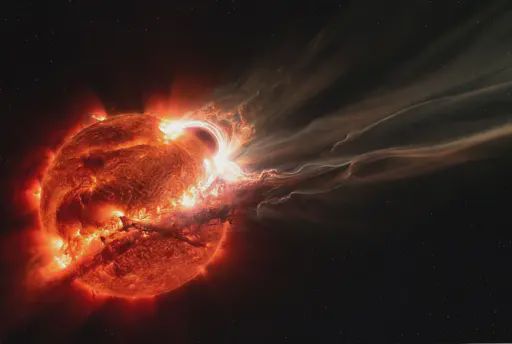
On the other hand, CMEs are big balls of plasma farted out by the sun. They can be massive and carry much more energy than a flare emits, and if a big one hits the earth, the earth’s magnetic field and satellite operations can be disrupted. But CMEs are relatively slow-moving (arrival times are in the 12-36 hour range), so their arrival times on earth can be predicted with reasonable accuracy, and there are mitigating measures that can be taken by those who manage potentially affected infrastructure. For example, satellites can be oriented to minimize charge accumulation; grids can be decoupled along the east/west axis; critical systems can be temporarily air-gapped. Voltage transients from CMEs are much more gradual than those from electromagnetic pulses (think a whoosh rather than a shock wave), so electronic devices are generally at low risk. Long ago, US and Canadian telegraph and grid operators were at risk of big induced voltages, but it’s long been known that the effect of CMEs on such infrastructure is proportional to the east/west component of the length of the conductor, so temporarily breaking the conductor into smaller segments limits the impact. Big-ass capacitors also help. There’s a whole notification system that alerts affected infrastructure operators when CMEs are coming, though the DOGE red guards attempted to sabotage the US part of that, along with any other science that might benefit people. It’s still going, but the people running it have been under budget and staffing pressure.
RecursiveParadox@piefed.social
on 27 Jun 14:54
collapse
Thanks for the helpful and reasonable explanation.
threaded - newest
All hail the sun god
<img alt="" src="https://sh.itjust.works/pictrs/image/84a4cb38-135d-4bd5-bdf6-74960c877f93.gif">
Just what we needed right now. 👌🎯
Will it affect computers?
Almost certainly not.
The article’s kind of crap since the headline conflates the effects of solar flares and coronal mass ejections (CMEs). Both increase according to solar activity (which is cyclical), but the correlation between flares and CMEs is far from exact, and the same goes for the relative magnitudes of each, except for the underlying principle that more solar activity means more frequent and more energetic flares and CMEs. So it’s a good time to heighten monitoring, but not worth freaking out about.
Flares eject highly energetic particles at very near the speed of light, so you don’t know about it until it hits you. But they only affect us at all if they’re aimed at the earth, their focus is very tight, and most of the particles get trapped in the earth’s ionosphere. The rest don’t carry charge and we generally aren’t affected by them.
On the other hand, CMEs are big balls of plasma farted out by the sun. They can be massive and carry much more energy than a flare emits, and if a big one hits the earth, the earth’s magnetic field and satellite operations can be disrupted. But CMEs are relatively slow-moving (arrival times are in the 12-36 hour range), so their arrival times on earth can be predicted with reasonable accuracy, and there are mitigating measures that can be taken by those who manage potentially affected infrastructure. For example, satellites can be oriented to minimize charge accumulation; grids can be decoupled along the east/west axis; critical systems can be temporarily air-gapped. Voltage transients from CMEs are much more gradual than those from electromagnetic pulses (think a whoosh rather than a shock wave), so electronic devices are generally at low risk. Long ago, US and Canadian telegraph and grid operators were at risk of big induced voltages, but it’s long been known that the effect of CMEs on such infrastructure is proportional to the east/west component of the length of the conductor, so temporarily breaking the conductor into smaller segments limits the impact. Big-ass capacitors also help. There’s a whole notification system that alerts affected infrastructure operators when CMEs are coming, though the DOGE red guards attempted to sabotage the US part of that, along with any other science that might benefit people. It’s still going, but the people running it have been under budget and staffing pressure.
Thanks for the helpful and reasonable explanation.
Again?
Forever until the sun burns out.