Cubans turn to electric vehicles as US tightens oil blockade
(www.reuters.com)
from MicroWave@lemmy.world to world@lemmy.world on 16 Feb 2026 23:03
https://lemmy.world/post/43224410
from MicroWave@lemmy.world to world@lemmy.world on 16 Feb 2026 23:03
https://lemmy.world/post/43224410
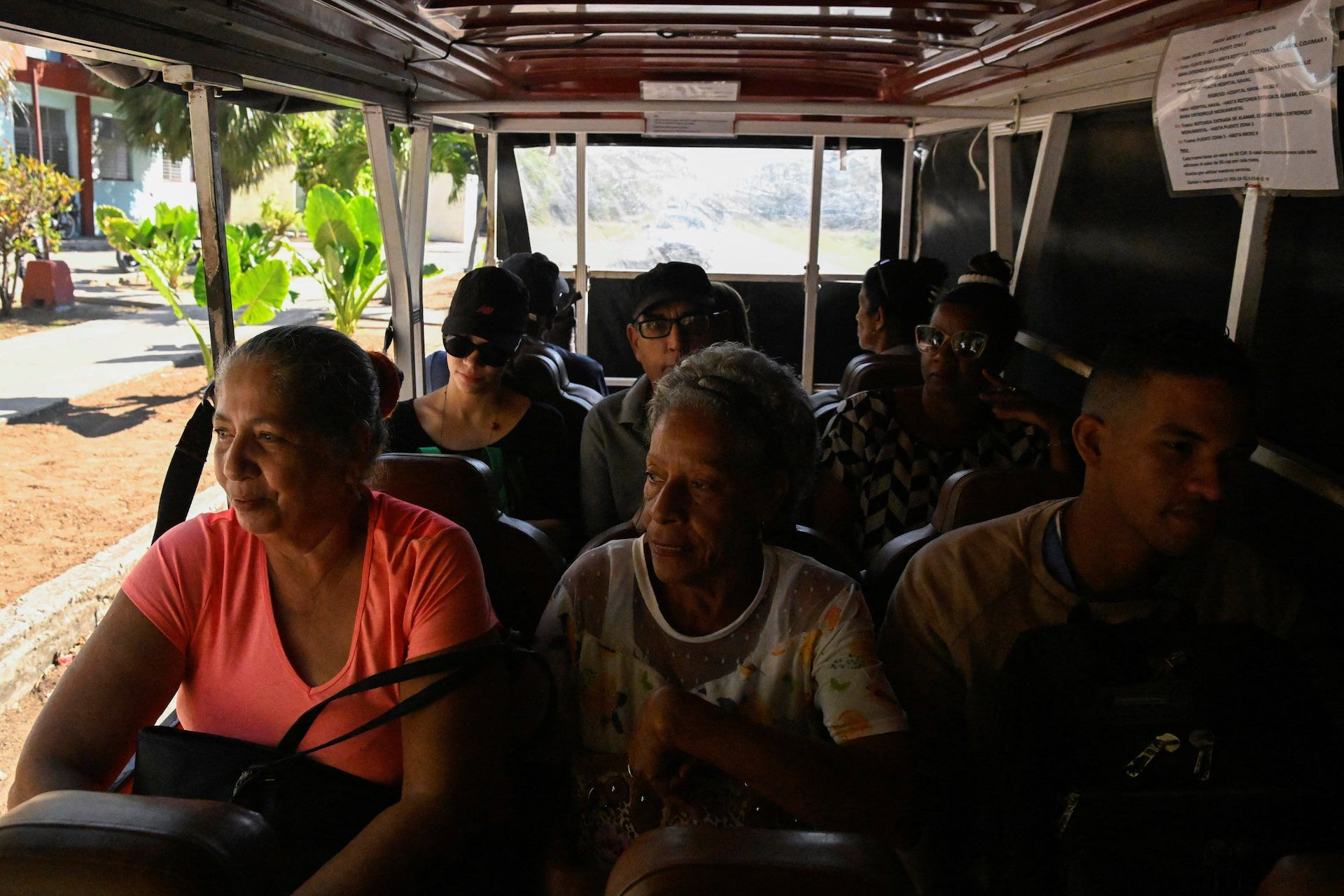
The rumble of 1959 Chevrolets, once the rhythmic heartbeat of Havana, is fading to the near silence of electric vehicles as the island faces its worst fuel shortage in years.
For six decades, Cuba’s roads changed little, defined by colorful vintage cars. But in recent years, Cubans increasingly adopted electric vehicles as fuel became more scarce. Now, they are helping the population grapple with a worsening fuel crisis, since the U.S. cut off oil exports from the communist-run country’s ally Venezuela and threatened to penalize other countries exporting fuel to the island.
Donald Trump’s administration has declared Cuba “an unusual and extraordinary threat” to U.S. national security.
#world
threaded - newest
US policy forcing cuba into a green socialist utopia lol.
Ya love to see it!
Island nations make the most sense to convert anyway. Import costs for consumable resources are already astronomical, why wouldn’t you switch to tech that can be completely self sufficient locally?
Which parts are self sufficient for Cuba? The electricity generation? They don’t have all the components to make lithium batteries.
There’s gotta be initial imports. Afterwards, they can be self-sufficient running these things and not be dependent on fuel imports, though.
Once they have enough lithium in the country, it could last them for decades, if they adopt a clever recycling strategy; not unlike they did with the 1950s cars.
Battery recycling chain will take 25 years to establish, when one generation of electric vehicles needs to be remade.
I meant the fuel, yes. There’s always going to be imports with highly advanced machines.
I’ve always thought this too, but Japan, and specifically Okinawa (where I live) are so reliant on fossil fuels. I figured we’d have solar panels on every home, offshore wind, and maybe even lead the innovation for tidal energy but nope.
Japan is a huge island in size and population compared to Cuba. And of course they kept importing oil and gas from Russia…
Okinawa isn’t on one of the home islands
<img alt="" src="https://lemmy.world/pictrs/image/4a8717da-2a50-4f71-ac0c-881c18cffd36.jpeg">
It’s tiny compared to Taiwan, much less Cuba
I’m not seeing how that’s relevant. It’s bigger, yeah, but still an island nation with the same import cost issue that empireOfLove2 mentioned. Does being bigger and more populous somehow cancel that out?
The scale generally does preclude them from adopting less mature technologies.
From the governmental side they did go all-in on nuclear for most of their later years. which works to a point.
Netflix made a documentary about the European islands that prioritized switching away from oil: Islands of the Future.
I would say with China’s help, a renewable Cuba is entirely possible.
My only concern is the hazards introduced by hurricanes, which can be compensated for by implementing flush roof-mount solar PV systems (minimizes wind loads), underground electric power lines, subgrade geothermal loops with heat pumps, indoor substations and Battery Electric Storage System (BESS) facilities, and pumped storage hydropower utilizing Cuba’s mountain ranges. Wind is probably not a viable technology given that hurricanes can completely cover the island with crazy strong winds.
Edit: as another commenter pointed out, tidal power would be a good alternative too. The best technology I’ve seen to utilize tidal is made by Orbital Marine Power based out of Scotland, who basically slaps 2 turbines onto a submarine to collect power. Could have offshore substations that collect that power and send it back to shore.
they are already the only country with a very high human development index and a ecological footprint smaller than 1.7 global hectares per person which is the threshold beneath which development can be sustainable.
source
but i’m afraid with the health and education system completely falling apart, especially in rural communities, this high hdi will not be maintained.
also there is no money for normal people to get any kind of vehicle, let alone electric.
if they are lucky and have some family abroad they might be able to source a solar panel, converter and battery, but going electric is far away, even if we consider the cheapest chinese EVs sold at 3000usd.
they might be able to pull it off in a different way, cubans have become really resilient and resourceful. old washing machine motors would be sold to transform into generators, normal one use lighters would be made refillable (the gas canisters would be reused insecticide cans), electronics would be fixed on a hardware level…
but that was before…on addition to the ever tighter embargoes and economical woes that come with it, since 2012 the population declined rapidly from a maximum of 11.2 million people to 9.75 million people in 2024, due to emigration and natural population decline through an ageing society source
Doesn’t Cuba punch well above its weight class when it comes to medicine, including universal free medical and dental? IIRC, hasn’t the US embargo basically fostered the development of Cuba’s own burgeoning biotech industry?
en.wikipedia.org/wiki/Healthcare_in_Cuba
I am sure that the US blockade has made life exponentially harder. Self reliance is one thing but access to raw materials is another.
OTOH they seem like a resilient people. If there’s anywhere on Earth that exudes “Fine; I’ll do it myself” energy when dealing with America, Cuba is it. I hope this makes them even stronger. I hope they find a way to completely circumvent America. I actually hope that for the whole world.
they definitely do punch above their weightclass, they’ve developed a vaccine against a certain type of pulmonary cancer, developed their own covid vaccine etc.
the thing is the lack of money and professionals to keep the system running.
apparently since the new constitution of of 2019 was approved, which amongst other things (re)affirmed the right of private property and foreign investments and opens the economy up to a market economy, the state has been reducing funding for education and health systems, which is especially apparent in rural areas. The direction to a more privately owned system is set and taken.
a fairly omnipresent example is medicines: during covid the state dropped the customs duty on medicine, in order to alleviate supply chain problems, so individuals could import medicine from around the world. this trend is ongoing, you will see a lot of whatsapp statuses of people offering and looking for certain types of medicines. Also a lot of selling and reselling of any imported goods such as generators, motorbikes, air conditioning, etc. is going on through whatsapp and other social media market places. a lot of people have internet on their mobile phones nowadays, they no longer rely on “el paquete”.
Could you elaborate a bit more on the issues around shortages of funding and professionals?
My understanding was that Cuba has had one of the highest doctor-to-population ratios in the world, and that its medical schools were often treated almost like a public works project to train large numbers of physicians.
Is it an issue of brain drain (graduate qualifying and then leaving for greener pastures?)
(I’m not doubting what you say btw; just trying to address my own ignorance).
PS: El Paquete is exactly the example of “fine, I’ll do it myself” response I had in mind. At 1TB per week, that was/is one of the largest sneakernets in the world.
i’m just relaying on what my cuban friends have told me: yes, it’s mostly brain drain on one side, and on the other hand there is ever less resources due to dwindling tourism and ever more expensive petrol. at the same time that more resources are injected into these tourist and prestige areas where you have water and electricity 24/7 while the costs to maintain them are ever rising. i heard of local schools in the escambray mountains where there is no teachers anymore, and it’s neighbours themselves that are not qualified in a teachers capacity that take care of teaching the few remaining children. so less resources that are more concentrated. also Cuba is huge and has many different regions, what is true for Havana and los Cayos is not true for the eastern and southern regions, i assume the impacts vary but all go in the same direction
and yeah, the paquete was the bomb :)
I want to start seeing electric-converted 1959 Chevrolets.
There are actually some companies that specialise in this which is pretty cool. www.silentclassics.co.uk
Sounds cool but the chassis are way to heavy to be viable.
Which country isn’t considered a threat to american “national security” at this point
Saudi Arabia, Hungary and uh… Russia. Other adjacent authoritarians.
Hungary
Ah damn it, that’s what I meant. I can’t keep up, it was Eurasia last week. Corrected 😉
Israel
Any country that doesn’t have stuff that the pedofile class and Israel wants
It is quite funny that Cuba, a small, relatively poor country that has been embargoed for decades, is considered an unusual and extraordinary threat to American national security, compared to countries with fission weapons.
Do they have antimatter or something?
Considering that Cuba’s electrical generation is nearly 100% fossil fuels, I don’t see how this makes sense.
They’re probably getting tons of solar panels from the same source.
80% of their grid power is oil “right now” though. Changing to solar and batteries will take time.
Well, “right now” their power is probably 0% oil, as they have none.
Right - so moving to EV automobiles is… pretty pointless at the moment.
Well, most likely they have some EV panels to charge some of the cars, which is probably working better than the gas based cars, because again, they have no oil and no gas.
But yes, I agree, the main issue is not what car they have, the main issue is the US.
Most of the old V8s had been replaced with Lada 4 cylinders by the 90s.
It wasn’t romantic that they were stuck with 50s cars, then forced to keep them running with Soviet spare parts.
Isn’t the only reason they have so many is that American organised crime hid stolen cars in Cuba? Like a massive amount?
Given that Cuba’s entire grid has now failed, sewage is backing up into the streets, and nobody has access to food, water, medicine, or communications, I doubt a few Teslas are going to save them. Cuba is about to be known for mass starvation and disease, not electric vehicles.
The thing is that all this isnt surprising to Cubans at all. They have always more or less lived like this, which is why there has been an ongoing decade long trend to off grid or local grid solar. Also this is of course not about Teslas lmao. A basic electric vehicle is like the simplest fucking device ever. You can build an electric scooter for super cheap. Also turning something like one of these tricycles from gas powered to electric saves a lot of cost.
It’s one thing to go off-grid when your country has a functioning infrastructure and supply lines. It’s more than a little different when pretty much everything has collapsed, people are starving and desperate, and disease is running rampant due to lack of clean water and sanitation. I really don’t think many people in Cuba right now are thinking thank GOD I have my electric scooter!
As we should all to cut the ombilical cord with the oil industry and gain independence.
www.iea.org/countries/cuba
Maybe they can get a deal for electric cars and solar with China? Cuba is one of those places that could use an 800lb gorilla in their corner.
You just described the Cuba Crisis.
Why is it always “national security”? Make it “national interests” or maybe “national priorities”. They are more honest, yes, but also less transparent excuses.
Because the Department of Homeland Security has broad powers and very little checks and balances to it’s discretionary use by the Executive branch. It’s the thing people have been warning against since it’s creation after 9/11.
Our blockade on Cuba makes no sense.
It kind of made sense, for a bit, what with the whole nuclear weapons on the island thing, but it should quickly have stopped. Its entirely bullshit for the last 63 or so years
The thing about renewable energy is that the source is everywhere. Fuck oil.