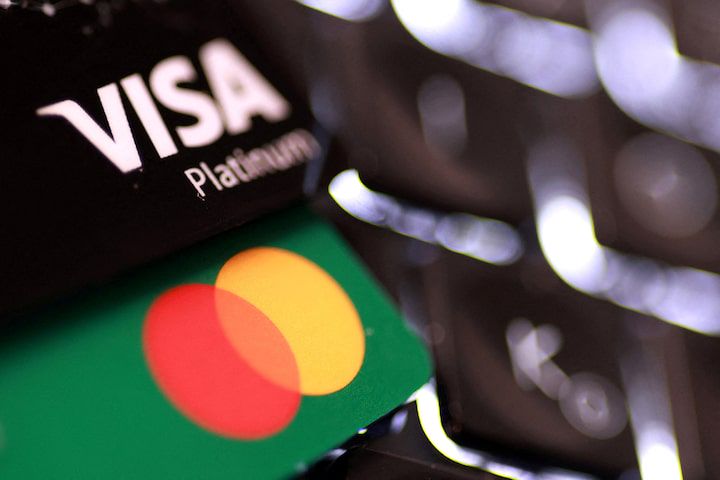
Cuba to suspend Visa and Mastercard transactions, citing US sanctions
(www.reuters.com)
from Wudi@feddit.uk to world@lemmy.world on 03 Jun 21:51
https://feddit.uk/post/50176068
from Wudi@feddit.uk to world@lemmy.world on 03 Jun 21:51
https://feddit.uk/post/50176068
#world
threaded - newest
Godspeed Cuba.
Thankfully I can still use my American Express!
I’m surprised Visa and Mastercard were allowed to operate in Cuba before this. Most US financial companies don’t serve the five countries on the US’s naughty list: Cuba, North Korea, Iran, Venezuela, and Russia.
Yeah, I’m also kinda surprised cuba apparently allowed them to operate there? There are few companies that more thoroughly exemplify the imperialist state than those two.
If I had to guess, it’s because Cuba had tourism.
Well, yes. The Americans have money. People like earning that money.
Nestlé? Amazon? HSBC? The fucking VOC?
Come on, there are a lot of evil companies but it’s crazy to pretend Visa and Mastercard are somehow the worst of them.
… The dutch east india company hasn’t been relevant for more than 200 years, but like fair enough. If you want to have “capitalist megacorp fightclub” that could absolutely be one of those few I mentioned. I’m gonna defend that “the primary architects of the global financial transaction system” are good entries onto the list though…
I feel like if you want to blame a company for creating the modern financial system, John Pierpont Morgan and the company which bears his name are probably 10x more responsible.
And that company isn’t even a little bit relevant right now, nor has my intent ever been to figure out which company is the “most to blame”. But neat, thanks for sharing your opinion, I will continue to consider Visa and Mastercard to be among the few absolute worst offenders.
J. P. Morgan is absolutely relevant in the modern day.
… J P Morgan Chase is not relevant right now because this is an article about Visa and Mastercard.
All of them, as long as their only reason to exist is to chase profit above anything else
Well sometimes in their pursuit of making money, their interests coincidentally align with those of the public and they make the world a better place as a result.
For example, Valve trying to protect their market dominance in the PC gaming industry has resulted in large improvements to game distribution, consumer protection, and convenience for computer game players.
Another example is the mail order drug company owned by Mark Cuban (the billionaire). He’s making buckets of money from it, but their profit model is to cut out the insurers to buy drugs from manufacturers at wholesale prices and sell them for cheap. So the medicines he sells are drastically cheaper. I actually am a beneficiary of this. I normally buy my medication from his company for $5 a bottle but one time I spilled it and had to get a refill from a local grocery store pharmacy which cost $100 a bottle (insurance paid $85).
But at least the pills from the grocery store pharmacy were blackberry flavour.
And this happens purely by chance, and always temporarily. As soon as it is financially better for them to throw you to the wolves that’s what they’ll do next
Sometimes. But even if it is temporary, it’s still good while it lasts.
Nothing too deep about it. That’s the whole thought.
Those two companies have a lot more power and influence than I think they actually want anyone to grasp
Should be 100% nonprofit and owned by the public. Totally worthless to humanity that they remain as businesses.
Most of what they do should just be FOSS anyway or the equivalent.
Unless you want to count Bitcoin (which technically is a free and open source payment network), payment networks really do need a central organisation to run the network and do the record-keeping. Decentralised payments really just don’t have the properties desirable for modern financial systems
None of what they said precludes centralization. You can have a centralized FOSS platform, like the Linux kernel, for example.
Also, I don’t necessarily subscribe to your premise. It needs to be organized, but I don’t think I agree it needs to be centralized.
Aye, I suppose your right on the first one.
With modern fiat money though I don’t see how any model other than a centralised one could work. The Government’s backing is what gives it value. Blockchain is just a way to have 1000x the people each spend 100x the resources just so it isn’t one entity running the show.
I don’t use it, but modern blockchain isn’t how it used to be. It’s no longer proof-of-work, where you do a bunch of computation for nothing (with a few exceptions that still do this).
Basically, what’s required is just a receipt that says “X owes Y $Z”, and that needs to be accepted by nearly everyone. That’s essentially what blockchain is, and it’s also what banks and payment services do. You just need a system you can prove is secure and accurate. Centralization is one option for this, but I see no reason for it to be required.
Also, I disagree that this works because of government backing. That has to do with currency, and there’s no reason this needs that. We just need to track value exchanged. It doesn’t even need to be a real currency as long as we agree on the value and it’s stable. Government backed currency is an option for this, but not necessary.
In addition, any payment provider, centralized or otherwise, can use this currency. Nothing about a government backed currency makes it unsuitable to be used for a decentralized payment processor. The only thing that matters to that functioning is that it’s secure and reliable. It could use USD, Bitcoin, or cows for all the user cares, as long as it’s stable and they can get their value when they need it. Payment processors usually use whatever local currency is, but they aren’t actually using that money. That’s a display. It’s exchanged when needed, or there would be a ton of processing that isn’t required.
I’m sorry, but you’re describing an open-source, decentralised, peer-to-peer, permissionless digital payment network. Which is exactly what cryptocurrency is. But I think you know that if you openly advocate in favour of cryptocurrency here, you instantly get downvotes on Lemmy. So you’re doing it in a fairly roundabout way.
I don’t know where you get the idea that blockchains are no longer proof-of-work. Bitcoin is still the largest cryptocurrency and it’s still using proof-of-work. It’s not really what I’m getting at though, when I say that a decentralised system is 1000x the people each doing 100x the work. Even a proof-of-stake system will still have a lot of work that each node has to do, validation transactions, and that amount of data that has to be passed around serves as a ceiling on transaction capacity. Bitcoin is notoriously low at 1 (“virtual”) MB every 10 minutes. But even larger limits or Ethereum’s sharding strategy would be utterly overwhelmed by the transaction volumes of traditional finance.
To clarify for others bitcoins transaction limit is a choice. Bitcoin blocks originally had no limit. One was put in place to limit spam. The restriction could be lifted now but doing so would increase the storage and bandwidth requirements for nodes.
I mean good TBH modern financial systems need to collapse for us to survive.
Lemmy loves open source except if it is bitcoin or Ethereum. I don’t get why so many are so happy for their government to be able to control their wealth through currency manipulation. Plus governments also use money to suppress dissent or ideas the gov’t doesn’t like, aka things like Wikileaks.
Totally agree
I’m glad most countries are developing their own national payment systems to get away from those leeches. The US central bank actually developed its own instant payment system called FedNow but you’ve probably never heard of it. Wonder why? Because participation is voluntary and banks aren’t required to give their customers access to it…
I actually have! And for more fun this admin is currently trying to fuck with FedNow, becuase of course they are
I hope they can get on-board with whatever the EU does to make a competitor.
Hope to see other countries do it as well soon!
Long live cuban revolution