from TheTechnician27@lemmy.world to vegan@lemmy.world on 09 Apr 17:49
https://lemmy.world/post/45389729
Firstly, I want to say that I’m sorry this makes 2/2 pinned posts related to health when veganism isn’t even fundamentally about it. The current one is just there as (I think) a pretty nice cheat sheet for vegans and debunk for common misconceptions – given human health isn’t a central tenet of veganism but is a central tenet of humans who’d like to stay comfortably alive.
“Why make this post?”
I’m writing this because a well-meaning post with this image made me groan and that’s apparently all it takes:
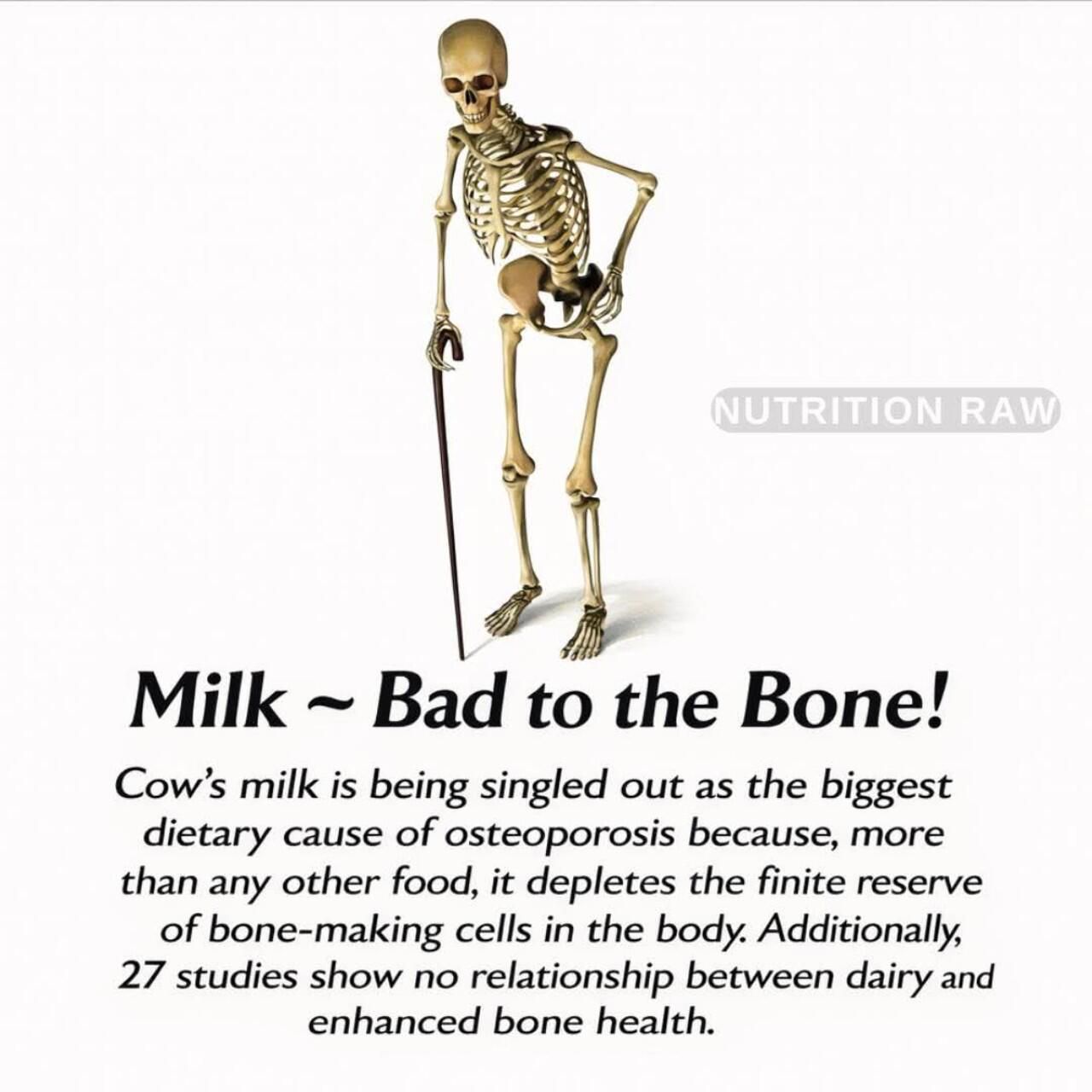
I’m going to try to be thorough-ish here, but I hope it’s for a good reason: I want to convince you that sharing poorly sourced garbage (even if you truly believe it) is hurting the cause you think you’re fighting for. I’ll start off by using this post as a case study in why it’s problematic.
"What’s wrong with that image?"
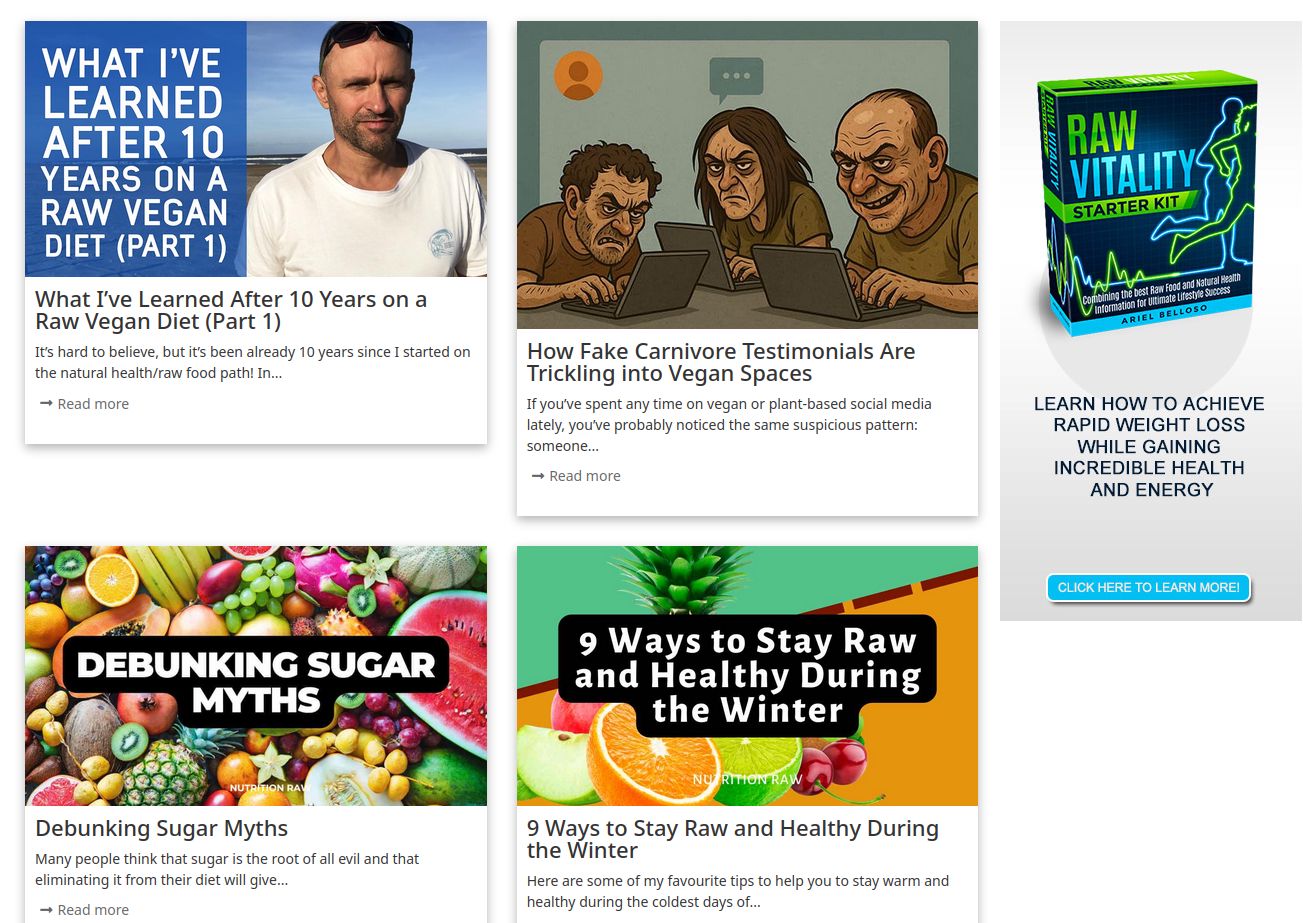
- It’s from a heavily biased blog/shop (see screenshot below).
- It has an indirect financial incentive for people to believe its message.
- It has a direct financial incentive to make highly spreadable images with its watermark.
- The site’s maintainer lacks any credentials in nutritional science (and it clearly shows).
- There’s no editorial oversight/peer review for something like this.
- It never cites “singled out as the biggest dietary cause of osteoporosis”.
- It never cites the supposed reason.
- It also calls osteoblasts “bone-making cells”, which like, fine, I guess.
- More importantly, it calls osteoblasts “finite”, which is utter horseshit.
- It never cites or gives any way to find those “27 studies”.
- Gathering up a bunch of individual studies with no regard for individual quality when meta-analyses definitely exist (see below) is the most fucked way to do this and is clearly cherry-picking.
- Maybe it’s referring to a meta-analysis of 27 studies, but a meta-analysis, unless the data is unbelievably clear, very rarely would have all of the studies unanimously finding no effect. Also, referencing a single meta-analysis makes citing trivial.
“But hang on, that’s mostly circumstantial!”
That’s 100% true. Sloppy practices and dubious financial incentives don’t mean the information is wrong. A random search on the Library of Babel might bring me to the cure for ME/CFS. Jordan Peterson may make a valid point about my diet. The reason I listed all those “heuristic”/circumstantial problems is because they’re most common in incorrect garbage and least common in factual, verifiable health information.
I lied: those weren’t the only wrong things.
I’m just going to single out the “no relationship” part, because this is low-hanging fruit, and maybe debunking it can teach some good lessons.
Definitions. Please skip if you’re comfortable with scientific research.
For those who don’t read scientific literature much, there may be some terms that you don’t know that I’ll frontload here (kind of simplified). Usually papers are done as studies. In the case of nutritional science with human participants, this means you’ll test a hypothesis on some number of people and report your findings. Sometimes, like in so-called “pilot studies” (low-cost, low-confidence studies where you run a very minimal version of the experiment to see if there may be a connection worth exploring further), there are very few participants, while some studies have hundreds of thousands of people in their data (e.g. a “cohort study”). There are other factors than just raw numbers to consider like methodology. Each study will try to assess what they think they found and the confidence in those findings.
A so-called “meta-analysis” (usually accompanied by a “systematic review”) is a statistical analysis of a bunch of different studies, and a systematic review is trying to take findings from a bunch of studies and figure out what they collectively mean. They’re usually together because a meta-analysis is a strong statistical tool for a systematic review, and a systematic review is a good way of making human-readable sense of a meta-analysis and filling in gaps that a statistical model may not measure. An “umbrella review” (somewhat rare) is a review of systematic reviews/meta-analyses, i.e. it’s a review of the reviews.
(Also there are case studies. Don’t use these as a source for generalized claims, please; you’ll look like a clown.)
The punchline
Getting to the punchline: generously assuming those 27 studies exist and are of any reasonable quality, they’re completely blown out of the water regardless by this 2025 umbrella review and meta-analysis (open-access), titled: “Dairy Consumption and Risk of Cardiovascular and Bone Health Outcomes in Adults: An Umbrella Review and Updated Meta-Analyses”. First, let’s get this out of the way:
This research was funded by Dairy Farmers of Canada, grant number 425231. The supporting organization had no involvement in the design of the study, the collection, analysis, or interpretation of data, the writing of the report, or any restrictions regarding the submission of the report for publication.
The authors publicly declare this, and it’s fine to be skeptical of funding, but this was a collaboration of staff from multiple universities, this kind of thing is actually pretty common, they explicitly declare the DFC had no involvement outside of funding, and overall, the meta-analyses are out there, and they cite their sources within the paper itself for you to check if you smell bullshit. The only small mitigating factor is that it’s published by predatory publisher MDPI, but Nutrients itself is a decent journal. When the evidence is fairly strong in their favor (remember this is an umbrella review; they know the existing data), it’s totally reasonable for an industry to throw money at an umbrella review knowing it’s likely to benefit them if the authors just do their job. If you’re willing to accept that overall (and you should be over some BS, Facebook-tier meme’s credibility), here’s the gist:
This review suggests that dairy consumption, particularly milk and yogurt, is modestly associated with reduced cardiovascular risk, while dairy intake appears to benefit BMD [bone mineral density] and fracture prevention. However, further research is needed to confirm these associations.
Before you say “But it said further research is needed!”, literally everything in nutritional science says that because it’s true. “More research is needed” is functionally a formality, like a “Warm regards” concluding your letter to your boss. If a study isn’t confident in its conclusion, it will tell you directly by examining things like methodological flaws that probably made its results less accurate than they could be. There’s a longer ‘Conclusion’ (Section 4) at the bottom with room to express more nuance, but saying it with so few caveats in the abstract is telling. Nevertheless, this includes 6 meta-analyses (33 total, but 6 for bone stuff) and blows “27 studies I’m sure exist” completely out of the water.
In sum, that just completely fucks “no relationship” compared to the meme’s “evidence”. It’s not the end-all. Nutritional science doesn’t have a set end point. It even has contradictions sometimes that are hard to sort out, like one study versus another similar one. However (spelling it out, but hopefully you understood this), here we’re talking 27 alleged studies with no information about their quality, dates, etc. compared to a 2025 umbrella review and meta-analysis of 6 meta-analyses, which is experts performing the studies beneath experts reviewing the studies collectively beneath experts reviewing those reviews of the studies collectively.
“Dude, what the fuck?”
Yeah, I just broke down why an anti-dairy meme is wrong or at least excruciatingly dubious in a stickied post on a vegan community. Firstly, like a shitty video essay, let’s take a step back to remember that veganism is:
a philosophy and way of living which seeks to exclude—as far as is possible and practicable—all forms of exploitation of, and cruelty to, animals for food, clothing or any other purpose; and by extension, promotes the development and use of animal-free alternatives for the benefit of animals, humans and the environment
That’s the reason we’re here. A plant-based diet (especially when you stick close to a whole foods plant-based diet) can have incredible health benefits, but that is coincidental. I would be vegan regardless of if it had no health effects or even if it were (practicably) negative; to me, it is an ethical stance. However, I’m endlessly grateful that this ethical stance aligns with a diet that has incredible health benefits. (Read the other stickied post for what some of those are, with receipts.) We’re not here to spread 1990s, “Got Milk”-tier propaganda about how your skeleton will waste away into a marimba if you don’t drink it every day for breakfast. However, especially when medical science overall is undeniably on our side, we should have no problem being nakedly honest about everything it says – not just the good parts. Because cumulatively, it still paints a picture that a whole foods plant-based diet does what no (or vanishingly few) omnivorous ones do – far from leaving you a protein-deprived, micronutrient-deficient, cud-chewing husk like the popular consciousness dictates.
Poor nutrition will obviously scare off non-vegans who want to stay healthy. Good nutrition will obviously encourage them to try it and make it easier for vegans to be vegan. So it’s obviously desirable to further our ethical goals that veganism should be as healthful as it can – that we’re all collectively informed of a plant-based diet’s benefits (like substantially lowered risk of chronic diseases like CVD, diabetes, and cancer (see other stickied)) and a plant-based diet’s downsides (like risk of consequential micronutrient deficiencies) and that we accurately and responsibly convey this to others.
- Solid scientific evidence is more convincing than a shitty Facebook meme to someone looking to become vegan and worried about health outcomes.
- Not sourcing your shit (where sourcing is usually very easy once you know the source) often means you haven’t verified the information for yourself, which is especially dangerous when your secondary source is garbage.
- Properly understanding the healthfulness of a plant-based diet makes veganism easier for you.
- Sourcing your shit lets people easily call you out if they think you’re wrong, and far from being a downside, correction is the most likely way you’ll learn otherwise when you already believe something.
- Spreading false, potentially harmful medical information 1) is against Lemmy.World Rule 8.1, but more importantly 2) is a great way to harm people, and even more importantly if somehow your only goal is furthering veganism 3) is the fastest way to add more poison to the well which is already so heavily poisoned against vegans.
The general, nonvegan public is already heavily distrustful against vegans:
- They see you like a Mormon whose goal is to convert them with no care about real conversation or about them.
- They see nutritional claims as ignorant at best or lying at worst to advance a movement – partly a defense mechanism because the most convenient way coincidentally also being the most healthy is great for their decision not to change anything about themselves.
- They’re going to be on high alert for bullshit claims, even minor, harmless, pedantic slip-ups.
- Not only are you squandering a chance to share a real, verifiable message, but if they find out, they’re going to become even more hardened against vegan messaging going forward.
- The kind of shit in the OP is so obviously ridiculous in its presentation that it’s going to turn off far more nonvegans that it turns onto the movement. If your goal is just preaching to the choir, then it’s cheap filler that makes vegans dumber about their own diet and ultimately weakens the movement.
- If someone starts a plant-based diet based on unsupported bullshit they’ve heard people say online (which fuck, they shouldn’t, but it’s 2026; look around you), if they have no idea what they’re getting into and think a plant-based diet runs on consensually given unicorn rainbow farts, they could legitimately get sick, trace it back to the diet, blame said diet and the vegans who shared misleading information, and not only permanently swear off veganism but also warn everyone they know that “I tried going vegan for two months, and it turned me into a lesbian seagull!”
“Well what can I do differently so you won’t be such a bitch about it?”
If you’re at least willing to entertain that spreading false/low-quality health information (accidentally or otherwise) can harm veganism (for which I’m just not going to entertain flimsy counterarguments right now because this is getting too long), you might feel powerless.
- Consult WP:MEDRS, which is the English Wikipedia’s separate standard for evaluating the reliability of a medical source. At most, this should be a 10-minute read and is denser and better than I could put here for evaluating sources. (While not perfect, Wikipedia’s medical coverage is often surprisingly accurate and reasonably complete for what it is.)
- Use something like PubMed Central (PMC), which is where that full-text version of the umbrella review was hosted. It’s a database hosted by the US’ NCBI, and it’s just there to aggregate papers from other sources. You can also try something like Google Scholar, although PMC (or PubMed if you want to be more inclusive, since PMC only does full-text) is likely going to be far easier if you’re targeting medical information.
- I don’t suggest adopting a “fuck the methodology” approach to reading papers, but the ‘Conclusion’ section can often get you 80% of the way there if you just want to talk about the findings of a study (especially e.g. a systematic review).
- On that note, try to use systematic reviews when they exist. Systematic reviews, as they’re “up the chian”, may become too general in their findings for you to be able to use them for your more specific claim, but also consider how strongly you want to make that claim when no systematic review exists. Systematic reviews are simply much more reliable than a layperson trying to aggregate individual studies and conclude something from them – they’re better at gathering relevant sources, having less bias, and leveraging far more expertise in both statistical analysis and their background in that field.
- At minimum, if all you have is a dubious shitpost like in the case study, actually try to verify the information yourself. I can’t count the number of times I was about to share something, did a last-minute spot check, and found out the entire thing was bullshit. And even if it isn’t, it can give you a better source to swap in.
- Aside from just using these sources yourself, give them to your readers so they can use them to learn more themselves and possibly call you out if you misinterpreted them. It’s healthier all-around.
- If you want to take it really far (way too far; this isn’t advice for posting anymore but moreso talking to people in other spaces), you can learn more about how these systems work. For example, on Wikipedia (thanks largely to a nutritional biochemistry PhD from MIT), we have surprisingly well-written, factual articles about micronutrients like Vitamin B12.
If anyone’s linking to this because you said something like “you die if your heart stops for long enough” and didn’t cite it, they’re severely misguided or not acting in good faith. It becomes problematic when someone makes real medical claims that aren’t common knowledge, aren’t obviously true, and that, if followed, could seriously harm someone (i.e. not something vague like “a cup of tea a day is good for you!” (but please also cite this; that’s neat if it’s true) or “the little snail thing in your inner ear is called the cochlea”). Something like “a plant-based diet has [blah] effect(s) on your liver” should be cited, because that’s not common knowledge at all (you’d have to go reading up on it or ask your doctor/dietitian), and someone who follows it (especially, say, someone with a liver disease) could be seriously harmed if it’s wrong.
Anyway, thanks for reading this bullshit. It could’ve been longer, but I tried to maximize animal suffering by making it reasonable to read to the end.
#vegan
threaded - newest