What a strange concept.
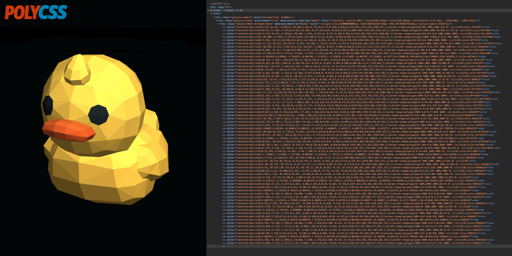
The demo is quite laggy on my phone, and has triangles constantly disappearing as it moves. Other online 3d viewers are able to load significantly larger models without any lag or graphical artifacts.
I don’t think the way this is implemented it can realistically use much GPU acceleration at all. It’s like taking all the vertex shaders and running them on the CPU, and then only using the GPU for triangle texture fill and depth testing… The hardware is right there, why avoid using it?
MonkderVierte@lemmy.zip
on 02 Jun 09:37
nextcollapse
Presumably, skipping those could increase performance? But maybe it’s not possible with this approach. I haven’t checked deeply. I guess it’s infeasible.
threaded - newest
Why store polies in tiny byte spans when you can store them in up to a KB each of markup?
What a strange concept. The demo is quite laggy on my phone, and has triangles constantly disappearing as it moves. Other online 3d viewers are able to load significantly larger models without any lag or graphical artifacts.
I don’t think the way this is implemented it can realistically use much GPU acceleration at all. It’s like taking all the vertex shaders and running them on the CPU, and then only using the GPU for triangle texture fill and depth testing… The hardware is right there, why avoid using it?
Just because you can, doesn’t mean you should.
But someone should!
Ooohhh this is a cool model. I really like the style. Also cool project lol.
spoiler
<img alt="" src="https://lemmy.zip/pictrs/image/6d8bde79-fc08-4bd5-9409-665efff2b848.avif">
Inspected, looks like even hidden-behind elements receive matrix transformation updates.
<img alt="" src="https://programming.dev/pictrs/image/8fed5823-c741-4360-b131-8b8a3557e45b.png">
Presumably, skipping those could increase performance? But maybe it’s not possible with this approach. I haven’t checked deeply. I guess it’s infeasible.