otacon239@lemmy.world
on 25 Mar 18:24
nextcollapse
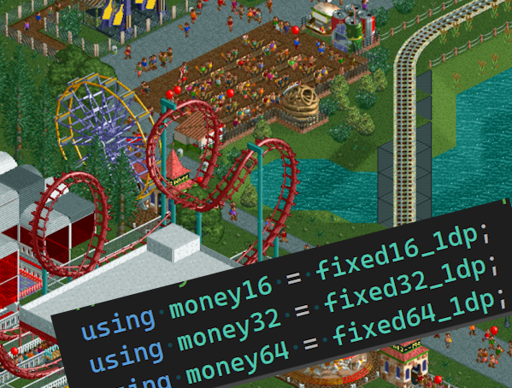
Running OpenRCT2 on a Raspberry Pi is probably one of my favorite pastimes. It’s such an incredibly well-crafted game that it will run on nearly anything.
I’ve been playing the Android port of OpenTTD, on an old and slow tablet. The input is a bit clunky, but tolerable.
Although, strictly speaking, the performance of OpenTTD and OpenRCT2 doesn’t follow from the original being so streamlined — seeing as they’re both reimplementations in C/C++.
TootSweet@lemmy.world
on 25 Mar 18:48
nextcollapse
I know the OpenTTD folks have been trying to deflect any ire from being directed at Atari, but man… fuck Atari for forcing them off of Steam and GOG. I really don’t think they have any legal leg to stand on and are just saber rattling to scare the OpenTTD folks into submission.
SlurpingPus@lemmy.world
on 26 Mar 02:10
nextcollapse
I’ve only recently and briefly looked into the US law on reverse engineering, which is what OpenTTD were initially doing — and apparently the EULA overrides the law in that case, while a lot of software has stock statements in the EULA that forbid reverse engineering.
What’s OpenTTD? How is this comment related to the article or the topic? Not being confrontational, just curious…
Edit: it’s an open source version of a transport tycoon game.
TootSweet@lemmy.world
on 26 Mar 18:31
nextcollapse
Yeah, I think basically the only reason why Transport Tycoon is in the news now-a-days is because they’re releasing a new edition of Transport Tycoon. And in preparation for that (basically to shut down who they see as “competition”), they’re fucking over everyone they view as potential competition.
To clarify further, ‘Transport Tycoon’ and its update ‘Transport Tycoon Deluxe’ are the direct predecessors of ‘Rollercoaster Tycoon’, with the latter using largely the same engine and being close in the interface. Both games benefited tremendously from having been made in assembly, allowing them to run on mid-nineties machines while juggling hundreds of simulated units and multiple views of the area.
Both games (and the sequel ‘Rollercoaster Tycoon 2’) were programmed by one dude Chris Sawyer, with art and music by other folks (also one per task for RCT, not sure about TTD).
I seem to remember some chess game that was written that accounted for the memory drum hardware that used it which i would think would be the gold standard… might be this one en.wikipedia.org/wiki/1K_ZX_Chess
Redkey@programming.dev
on 25 Mar 23:34
nextcollapse
Drum memory predates the Sinclair by quite a while. But there is an often repeated story involving an impossibly-optimised Blackjack program for a drum memory computer called “The Story of Mel, a Real Programmer”.
Sorry for nitpicking, but the notion of Sinclair ZX81 ever using drum memory is rather comical — seeing as the latter is quite a humongous hunk of junk.
Azzu@lemmy.dbzer0.com
on 26 Mar 07:01
nextcollapse
Btw the optimization for random walking of park guests makes for kinda shitty gameplay. Parks aren’t designed at all like real parks, and transportation rides are almost useless. It’s impressive for its time, yes, but the park simulation only visually looks good enough, it’s not really good enough.
If you play it like a model building game (not a theme park simulator) then it’s almost perfect.
threaded - newest
Running OpenRCT2 on a Raspberry Pi is probably one of my favorite pastimes. It’s such an incredibly well-crafted game that it will run on nearly anything.
I’ve been playing the Android port of OpenTTD, on an old and slow tablet. The input is a bit clunky, but tolerable.
Although, strictly speaking, the performance of OpenTTD and OpenRCT2 doesn’t follow from the original being so streamlined — seeing as they’re both reimplementations in C/C++.
How times have changed…
I know the OpenTTD folks have been trying to deflect any ire from being directed at Atari, but man… fuck Atari for forcing them off of Steam and GOG. I really don’t think they have any legal leg to stand on and are just saber rattling to scare the OpenTTD folks into submission.
I’ve only recently and briefly looked into the US law on reverse engineering, which is what OpenTTD were initially doing — and apparently the EULA overrides the law in that case, while a lot of software has stock statements in the EULA that forbid reverse engineering.
Ah. That makes more sense than anything else I’ve heard. Thanks for that.
What’s OpenTTD? How is this comment related to the article or the topic? Not being confrontational, just curious…
Edit: it’s an open source version of a transport tycoon game.
Yeah, I think basically the only reason why Transport Tycoon is in the news now-a-days is because they’re releasing a new edition of Transport Tycoon. And in preparation for that (basically to shut down who they see as “competition”), they’re fucking over everyone they view as potential competition.
To clarify further, ‘Transport Tycoon’ and its update ‘Transport Tycoon Deluxe’ are the direct predecessors of ‘Rollercoaster Tycoon’, with the latter using largely the same engine and being close in the interface. Both games benefited tremendously from having been made in assembly, allowing them to run on mid-nineties machines while juggling hundreds of simulated units and multiple views of the area.
Both games (and the sequel ‘Rollercoaster Tycoon 2’) were programmed by one dude Chris Sawyer, with art and music by other folks (also one per task for RCT, not sure about TTD).
I seem to remember some chess game that was written that accounted for the memory drum hardware that used it which i would think would be the gold standard… might be this one en.wikipedia.org/wiki/1K_ZX_Chess
Drum memory predates the Sinclair by quite a while. But there is an often repeated story involving an impossibly-optimised Blackjack program for a drum memory computer called “The Story of Mel, a Real Programmer”.
Sorry for nitpicking, but the notion of Sinclair ZX81 ever using drum memory is rather comical — seeing as the latter is quite a humongous hunk of junk.
Btw the optimization for random walking of park guests makes for kinda shitty gameplay. Parks aren’t designed at all like real parks, and transportation rides are almost useless. It’s impressive for its time, yes, but the park simulation only visually looks good enough, it’s not really good enough.
If you play it like a model building game (not a theme park simulator) then it’s almost perfect.