Can a reasonable person genuinely believe in ghosts?
from yizus@lemmy.world to nostupidquestions@lemmy.world on 26 Feb 01:35
https://lemmy.world/post/43583128
from yizus@lemmy.world to nostupidquestions@lemmy.world on 26 Feb 01:35
https://lemmy.world/post/43583128
A friend and I are arguing over ghosts.
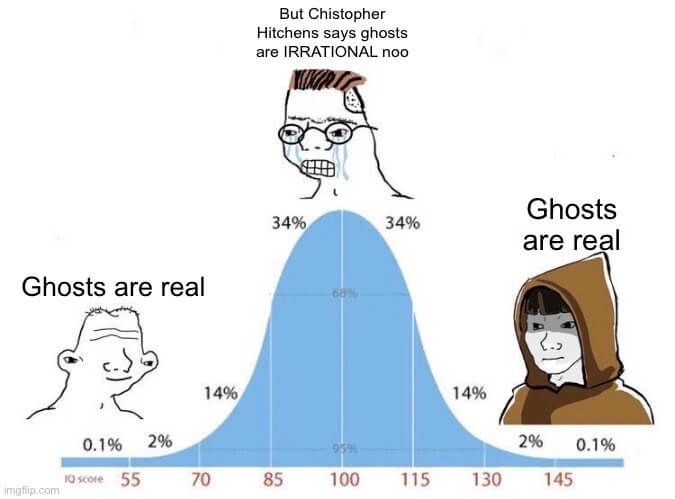
I think it’s akin to astrology, homeopathy and palm reading. He says there’s “convincing “ evidence for its existence. He also took up company time to make a meme to illustrate our relative positions. (See image)
(To be fair, I’m also on the clock right now)
What do you think?
#nostupidquestions
threaded - newest
The only evidence is anecdotal, there just happens to be a lot of it.
So no, I’d say it’s unreasonable to believe in ghosts. (Though I do love ghost stories and folklore.)
Reason on its own doesn’t bring enough to the table. Without critical thinking (and even with it) reason can lead to any conclusion.
If the data you reason on is flawed (and it is for everyone) then you’ll end up with wrong conclusions no matter how reasonable you are.
Real? Who cares? It’s fun!
Well, we care. That’s why I asked. It’s just that some people are certain about they position on this and refuse to back it up.
And of course it’s fun, I’ll happily suspend belief for 90 minutes to allow me to be creeped out by a good ghost movie, but that ends when the credits start rolling.
It’s not important that you believe in ghosts. It’s only important that they believe in themselves.
Science has never in the history of science reliably shown a single interaction between physical entities and any sort of non-physical force. The only way ghosts could be real is if you redefined the term “ghost” to the point of breaking, like saying that the memory of a person is a ghost.
Plus, it fails the smell test in a million ways. What makes a ghost exist? Why aren’t we positively lousy with ghosts? Are there rules? What would they be and what mechanism is there to both quantify and effect them? Why do ghosts follow the rotation and revolution of the earth but otherwise aren’t physically bound? How can one have any sort of cognition? If a ghost does, how can it perceive anything without intercepting photons or other physical phenomena? If there are ghosts and somehow they have cognition and perception, are we obligated to leave Netflix on when we leave for work?
Fucking magnets,
How do they work?
www.youtube.com/watch?v=_-agl0pOQfs
Magnetism is a physical force, like gravity. Measurable and consistent.
You keep saying “physical force”…
That’s not a real term in physics.
The only possible explanation, is you mean any force that is already explained by physics, is that what you mean?
Because that would be the same as insisting we know everything, which no one who knows anything about physics would ever try to claim.
So…
What exactly do you mean when you keep saying “physical forces”?
I mean there’s no way to go from immeasurable to measurable except in scale, and anywhere north of quantum scale, physics has been reliably predictable and measurable. Ghosts’ purported impact is on a scale well above that which is unexplained.
None of what you’ve said is n this thread makes any logical sense…
Which would be fine cuz it’s about ghosts, but you keep acting like physics backs up your wild statements and made up vocabulary…
I’m not making shit up as I go. If you don’t understand something, it isn’t consequently nonsensical.
en.wikipedia.org/…/Interactionism_(philosophy_of_…
The phrase doesn’t appear once in your link. Or anywhere else in reference to physics…
You 100% made that up, and at this point I don’t really care why
So you’re hung up on the phrasing “physical forces” not appearing in a textbook?
What vocabulary did they make up?
Why do you say ghosts’ purported impact is on a scale above that which is unexplained?
Quantum fields impact the universe on a scale above their own. It’s entirely possible that the explanation for ghosts is on the quantum scale or smaller, and the observable effects are just that: effects of a much subtler phenomenon.
Yes, quantum scale has macro effect, but the macro scale is predictable and rigidly causal, negating any meaningful quantum scale interactional impact. A macro causation effected via quantum interactions is a de facto macro interaction.
One of the definitions of "physical" in the American Heritage Dictionary is:
Nope.
Explain please?
The earth’s magnetic field is fluid and changing, magnetism is affected by electrical current or heat.
I don’t mean that any given magnetic field is unchanging, I mean that the principles are stable and well-understood. We never see magnetic fields just randomly change with no reason or else navigation and all kinds of other technologies would be fucked forever.
Technically, the moment science would show an interaction between physical entities and something else, that something else would immediately be classified as a physical entity. In a very real sense, the discovery of radioactivity involved physical entities being found to interact with an as-yet unknown, invisible, intangible force.
If ghosts existed, the same would happen as with radioactivity. They would be researched, hypotheses on their nature would be tested, and a scientific theory would arise, and then they would be a part of the “physical world” too. And then all the mystics would be bored with ghosts because they are just incorporeal noospheric echoes of old people, as boring as neurology or biochemistry or stellar fusion.
If a bunch of people were going around saying I got this weird burn on my skin after holding this rock for a while, scientists would have discovered radioactivity a lot sooner.
There are a bunch of people going around claiming to have interacted with ghosts, and we've got bupkis.
That reminds me of this meme:
<img alt="Hypothetical chart comparing the number of cameras to the number of sightings of both Bigfoot and Giant Squid. Bigfoot sightings do not increase with more cameras." src="https://mander.xyz/pictrs/image/84a14063-93f1-4138-8ffc-2ca622309c14.png">
I found it here after an internet search trying to find it again, but I’m not sure if it is the original source:
www.reddit.com/r/…/ill_just_leave_this_here/
The indigenous Australians, the Mirarr people, identified an area in Northern Australia as sickness country which was very coincident with a high concentration of uranium.
They just avoided the area instead of poking it
d28rz98at9flks.cloudfront.net/…/145214_00_0.pdf
Aw man. The northern tip of Australia has the cleanest air in the entire world. That data is from pre-y2k
Not sure about that, you might be thinking of the Southern tip. Indonesia often conducts burn offs with a lot of wind blowing smoke over Australia as well as cultural burning conducted by the indigenous in the region. I remember seeing the haze growing up and walking through the burnt country at the start of the dry.
I think you could rationally explore ghosts in the “radically redefining” them arena. Ghosts could rationally exist as an artifact of your mind, and saying that is not the same thing as saying they don’t exist. Hallucinations exist. They aren’t real, but they exist. Ghosts could rationally exist in the exactly same way, as processes in our own heads. It’s when you start saying they interact with the world in a way outside people’s heads that you can’t really reconcile.
Except that’s not what we mean when we talk about ghosts. Ghosts are meant to be actual beings with an actual existence, if very different from living beings.
The concept of ghosts exist (as does for all things for which we have words). Some people do believe ghosts exists, and some might have seen ghosts (just like someone actually sees a hallucination). All this doesn’t mean ghosts exist, or else the actual concept of non-existence doesn’t exist - which makes the fallacy evident: if we are to consider that all concepts actually exist (further than just an idea), non-existence has to exist.
Saying “science has never reliably shown something” is not the same as “science has definitively proven something false.” Claiming otherwise is anti-scientific and logically fallacious.
According to the scientific worldview, we don’t know what we don’t know until we know it. Otherwise, we would never discover anything new.
I’m not saying ghosts are real. I’m just encouraging a healthy skepticism, whether for or against. So I’ll play devil’s advocate and respond in turn to each of your “million ways” it fails the smell test.
We don’t know, but there’s a lot we don’t know. What makes gravity exist? What made matter and energy exist? What causes the big bang? What is the origin and nature of dark matter?
There’s a lot we don’t understand about the universe, so the answer could be as simple as a cloud of electrons or even photons, or as complex as a field of quantum fluctuations, dark matter, a previously undiscovered type of boson, a state of matter beyond plasma where the particles vibrate so rapidly that they’re mostly unobservable, a range of electromagnetic frequencies with wavelengths so fine that our instruments can’t detect them, or even an entity in a higher dimension that ephemerally crosses the plane of our familiar third dimension.
The answer depends on the above, but it could be that we are and just can’t observe them under ordinary circumstances. Or perhaps there’s a different place where they go, or possibly a different dimension, and we only notice the ones who get stuck here somehow. Or perhaps there’s some sort of ethereal ecosystem which keeps the ghost population in check like birds do for insects.
Probably, but there are plenty of rules in the universe we don’t understand. What rule is responsible for gravity? Why does dark matter behave the way it does? Why do quantum fluctuations behave the way they do? Why does spacetime behave the way it does? And why do quantum mechanics and general relativity seem to describe contradictory sets of rules for the same universe, albeit at different scales relative to the one at which newtonian physics are accurate?
Until we figure out unified field theory, dark matter, and that higher dimension thing, we can’t pretend we’ve described every rule in the universe.
This has already been addressed under “what makes them exist?”
It could be that their physically-boundedness is just subtler than most things we’ve observed. They could maintain their relative position gravitationally or by friction, or possibly through electromagnetism, quantum entanglement, exertion of conscious effort, or simply some higher-dimensionality which allows them to be present anywhere they want at a given moment.
How can any living human have any sort of cognition? There’s a lot we don’t understand there either. It could be that consciousness is a property of electromagnetic fields, in which case it would explain it if the ghosts were made of electron clouds. Or perhaps consciousness is a property of quantum fields, or something else we don’t understand such as a higher-dimensional entity with more complex states of matter and energy, that simply can only perceive and interact with the world in three dimensions because those are the limitations of the physical organism it has developed to inhabit and maintain itself.
So the answer to ghost cognition depends on the answer to human consciousness, which is still one of the major mysteries of the universe.
Alternatively, perhaps ghosts aren’t conscious at all and only appear to be, but they’re really more like a complex sort of jellyfish, mindlessly following patterns that were set by the mind of the conscious entity prior to the death of the physical organism.
Perhaps it directly perceives electromagnetic waves that enter its field of existence, or perhaps there’s some higher-dimensional perspective that allows them to observe the 3-dimensional world from the outside.
We don’t intercept photons when we dream, yet our brains construct images. So physical sensation is not a necessary precondition to mental perception.
I haven’t seen compelling enough evidence to believe in the supernatural.
That said, we do seem to be well on our way to engineering ghost-like phenomenon. People will set up LLMs and generative AI systems that imitate dead people, if they haven’t already…
No ghosts IRL? No problem! We’ll make ghosts!
Thanks Humanity. 🙄️
Like right after Charlie got Kirked Christians started sharing AI videos of him talking about forgiveness and shit.
Glenn Beck is making a “George AI” and Prager U in partnership with the White House are making Founding Father AI systems to lie to children about history and Christianity.
Horrifyingly there’s also HearAfter Ai.
they did that for Christopher Pelkey, so he could testify at his killer’s sentencing. For some travesty of justice, the judge was an idiot and allowed it as a “victim impact statement”.
Are you able to provide specific evidence that ghosts AREN’T real?
Can you prove there isn’t a teapot in orbit around the moon?
There might be for all I know!
Their point is that one could come up with a billion hypotheticals for what might theoretically exist, because we cannot disprove it. If we spent as much time humming and hawing whether each one actually does exist as we do for ghosts, souls, gods, Big Foot etc., then you won’t be doing anything else in life.
That’s why it’s a typical position to just say that they don’t exist until proven otherwise.
Or in the more general sense, this is Occam’s Razor: If there’s multiple possible explanations for something, then one should assume the simplest explanation until proven otherwise.
And if you hear a door slamming shut in your house, then wind is a much simpler explanation than ghosts.
Russell's Teapot orbits the sun. There isn't room in this solar system for two orbiting teapots.
Prove it!
yes.
the utter lack of convincing evidence that ghosts are real is evidence that ghosts are not real.
An utter lack of evidence thus far
and I’m sure you’re the one who is going to find the evidence.
it is not as though humanity hasn’t been looking for evidence of the supernatural since… well… probably before hommo sapiens were a thing…
gee…it’s only been thousands of years
Never imaged
Never measured
Never captured
Never seen by people without mental health issues.
I mean, it sounds like your friend genuinely doesn’t understand the scientific method. That doesn’t necessarily make them unreasonable. It just means they had a sub-standard science education.
He’s wishy washy on the scientific method, not because he doesn’t understand it but because he believes it’s wrong (or at least incomplete)
We’ve spoken about this on several occasions and either his arguments make no sense or I’m genuinely too dumb to get them.
Arguments against it typically make no sense.
Hi, I’m the friend. I don’t want to reveal too much about my identity here but my science education was actually very thorough (I know that sounds arrogant but I just wanted to defend my honour here). Let’s not get bogged down with personal detail though like that though because ad hominems like this can often cause a conversation to unravel into personal attacks.
Regarding what my friend said about my views on the scientific method: This is a bit of a mischaracterization. I don’t have anything against the scientific method. I just think that the set of things we have reason to believe is larger than the set of things that we can provide evidence for scientifically. (Broadly speaking I think this is a fairly standard view of things.)
Another way to out this is this. The question is not ‘is xyz scientific’ but ‘do we have reason to believe xyz’? It turns out that if we can demonstrate something scientifically it does give us reason to believe that thing. But there are some things we have reason to believe that we cannot demonstrate scientifically. For example I have good reason to believe solipsism is false, or that chocolate tastes more like coffee than soap, even though I cannot strictly speaking demonstrate these things scientifically (examples like this often have something to do with the subjectivity of the mind, which cannot be directly measured but is nonetheless very apparent to us).
For the ghost stuff, I think you actually could make a reasonable scientific case for the existence of ghosts (very hot take, I know), but that’s not my primary concern. What I’m worried about is do we have good reason to believe in ghosts? As it happens, I believe the answer to that is yes. The details here might be a bit out of scope for a c/nostupidquestions thread but I’m basing my thoughts here on the book Surviving Death by Leslie Kane. I used to have a similar view as most people in this thread (that ghosts were irrational and unscientific etc) until I read this book and it forced me to change my mind. It’s a great book and I highly recommend it for anyone interested in this topic.
Edit: for grammar and typos
Debunking: https://psychologycorner.com/skeptics-review-surviving-death-2021-netflix-original-series-movie-analysis/
I’m not referring to the Netflix series
I know, but seeing as most of the content comes from the book…
The book addresses these standard debunking claims that you find in this article. Most of these dubunking strategies only work if the person doesn’t know what they are talking about or are leaving out important details and lying by omission. I used to be very skeptical of this sort of stuff (and still consider myself to be a skeptical person, for example I’m still an atheist), and I was a fan of skeptics magazine and all the standard debunkers and the like. This only changed when I decided to actually read the source material and see for myself if there was anything there. It was a very eye-opening experience, because I realized I wasn’t getting the full story. I encourage you to do the same; read the book, but also read all the skeptical rebuttals, and then try to reason through it yourself. I think you will be surprised at what you find. I know I was.
What was it that convinced you?
Basically, there are reliable, repeatable and measurable effects that are best explained by people ‘surviving’ their own death. A good example of this is near death experiences. People come back from having been clinically dead and can tell you things that they shouldn’t know. For example like where items are placed on the roof of the hospital or events that transpired when they had no brain activity. These people would have no way of having knowing this stuff unless they’ve seen it for themselves, which would have been physically impossible. So this makes their own fist-person accounts of what happened (“I was out of my body and literally floating around”) start to seem more credible.
The power of the book is the sheer volume of cases it presents for these sorts of events and other related phenomena. It shows you that events like these do occur reliably and repeatably and are quite literally scientific in that people can and do study them scientifically (and more of this study should occur, but that can only happen if we get past the current social stigma).
The power of the book is that it just inundates you with credible stories (and credible science!) from credible people, all of which is suggestive of the supernatural. It might be possible to talk yourself into dismissing one or two of these cases, but when you have several hundred of them compiled back-to-back-to-back it becomes harder and harder to find the willpower required to muster up a skeptical response. After a while you have to admit “okay, theres something more going on here, and I don’t understand it”. At least, thats what happened to me.
It’s a great book though, and I’m not doing it justice. I highly recommend giving it a read.
Thanks for explaining. To be honest I’m still not sure why that convinced you. If you wrote a book with a few hundred, even a few thousand anecdotes about people levitating I would still believe in gravity.
That is the part I doubt the most. Because if that was true, if this so called credible science in your book wasn’t misinterpreted or simply faked, the scientists responsible would have gotten a nobel price and world wide recognition. But they didn’t. If ghosts (or near death experiences, for that matter) were measurable in a repeatable or otherwise credible way it would be done on a wide scale. Scientists basically live for the chance to be the one who challenges a paradigm - and this one would shake everything we know about the material world, every scientific discipline, religions even.
There’s simply no good reason for such “credible science” to go unnoticed. There is at least one very good reason for faking it: It makes money.
I believe in helium balloons too. Does that mean I don’t believe in gravity?
Why do you assume that these scientists would get nobel prizes? Science is still a cultural phenomenon and people have their prejudices. Stigmas exist (as this thread amply reveals). Einstein didn’t even get a nobel prize for special relativity because it was considered too radical at the time.
And why do you assume this science has gone ‘unnoticed’? We’re talking about it, aren’t we? People have spent their lives studying it, and an entire university department at Princeton is devoted to studying these sorts of things. This sort of stuff is frequently brought up and debated in reputable journals such as the Journal of Consciousness Studies (which recently devoted an entire issue to debating the topic of near death experiences iirc). That doesn’t sound very unnoticed to me. Controversial? Sure. But not unnoticed.
Well then you should read the book. Like I said I’m not doing it justice. If you’re actually interested in this topic, and not just interested in taking cheap shots on Lemmy, then read the book.
Physics can explain helium balloons really well. There’s no mystery here. And they’re certainly not disproving gravity.
Einstein had no easily repeated experiments to show off. You’re claiming ghosts are measurable in a repeatable way - simple enough to be explained in a book for laypeople . At least after the third or fourth study with robust methodology the scientific community would be talking about nothing else. And I know that because I am surrounded by the kind of researchers you’re thinking of when you say “scientists”. They’re a bunch of nerds, they love that stuff. And they research ominous stuff all the time, a biology professor here spent 3 years studying healing crystals in drinking water. Disappointingly they found nothing.
Well to be fair we’re talking about a claim that such research exist, which is miles off from discussing actual research, which would be done by scientists in order to validate it’s operationalisation and discuss their findings.
The thing is: extraordinary claims require extraordinary evidence. A book simply isn’t that. It’s way too easily faked, isn’t subject to the scientific method, peer review, any form of control or critical oversight and at the end of the day profits not from the truth but from being sold. And you are here doing advertising for them, so it seems like they are succeeding at that.
I’m not trying to persuade you. I believe that would be hard to do at this point. What I’m trying to say here, referring to the thread and OP’s question: It’s not unreasonable to think that you, and everyone else being convinced by a very entertaining and captivating book outside of the actual scientific method, are unreasonable.
One book simply shouldn’t be this convincing.
Okay, I revise my request. Please just read the books bibliography and read the peer-reviewed research that it cites.
Out of curiosity I just checked if I could find it. I couldn’t, which isn’t surprising - a book isn’t a scientific publication, so sources are rarely of great interest.
But in general: It would take hours, maybe days of work to cross reference the sources of a whole book with what the author claims they prove. Obviously I won’t do that. How many papers from the bibliography have you read? If you own the book, at least you should have easy access to it’s sources.
I am familiar with the sources, yes.
I’m not sure what you’re looking for here. Do you want me to send you links to some of the research from the bibliography? If so then I can do that when I get home from work
I’m trying to show you that your case isn’t convincing.
If your book could logically prove something, or at least argue convincingly (logically!) in favor of it, maybe it would in fact be interesting. Then you could repeat the arguments here (and elsewhere, and scientists would be doing just that) and we’d actually have some kind of discussion with something to gain for both of us. Anecdotes are, scientifically speaking, basically worthless. At best they’re used to create hypotheses, never to test them or to prove something. And even a great sum of them simply aren’t science.
And I’m sorry to say but this very much reminds me of conspiracy theories, e.g. flat earth theory, were science is really clear about something while a few laypeople on youtube think to themselves “I bet all those researchers just didn’t think of this, which to me on the other hand is completely obvious”.
Your claim is absolutely extraordinary. You would have to present an absolutely powerful, convincing logical argument in order to even begin to support it. “Someone claimed it happened to them” simply isn’t that, no matter how well it’s written.
You seem to be mistaking a logical arguments for an empirical argument (you don’t “prove” things in science the same way you prove things in math or logic). I’m making an empirical argument, not a logical argument. But in order for an empirical argument to be convincing you need to actually look at the data. This seems to be something that you’re very adverse to doing. You don’t want to read the book. You don’t want to review its bibliography. And you turned down my offer for me to literally send you sources here in this chat for us to discuss. So I really don’t know how else I can help you at this point. If you’re really so sure that you can prove (logically?) that this data is not worth looking at then there is really nothing further for us to talk about.
Who’s the one literally refusing to look at the data here? Me or you?
My patience with you here is running thin. I offering to send you peer-reviewed research and now you’re dismissing it all wholesale as just anecdotes? Note that (a) this is simply false and (b) case studies are an important part of all research in psychology and medicine (which are the subject matters we are dealing with here). I don’t have the patience to get into the weeds on this with you, so if you’re actually interested and not just trying to save face then please refer to this comment I made here.
Please do not respond to this message unless you have something actually intelligent to contribute to the conversation.
He shouldn’t have gotten one for SR specifically anyways because Hendrik Lorentz had already developed a theory that was mathematically equivalent and presented a year prior to Einstein.
The speed of light can be derived from Maxwell’s equations, which is weird to be able to derive a speed just by analyzing how electromagnetism works, because anyone in any reference frame would derive the same speed, which implies the existence of a universal speed. If the speed is universal, what it is universal relative to?
Physicists prior to Einstein believed there might be a universal reference frame which defines absolute time and absolute space, these days called a preferred foliation. The Michelson-Morley experiment was an attempt to measure the existence of this preferred foliation because most theories of how it worked would render it detectable in principle, but found no evidence for it.
Most physicists these days retell this experiment as having debunked the idea and led to its replacement with Einstein’s special relativity. But the truth is more complicated than that, because Lorentz found you could patch the idea by just assuming objects physically contract based on their motion relative to preferred foliation. Lorentz’s theory was presented in 1904, a year before Einstein, and was mathematically equivalent, so it makes all the same predictions, and so anything Einstein’s theory would predict, his theory would’ve also predicted.
The reason Lorentz’s theory fell by the wayside is because, by being able to explain the results of the Michelson-Morley experiment which was meant to detect the preferred foliation, it meant it was no longer detectable, and so people liked Einstein’s theory more that threw out this undetectable aspect. But it would still be weird to give Einstein the Nobel prize for what is ultimately just a simplification of Lorentz’s theory. (Einstein also already received one for something he did deserve anyways.)
But there are also good reasons these days to consider putting the preferred foliation back in and that Lorentz was right. The Friedmann solution to Einstein’s general relativity (the solution associated with the universe we actually live in) spontaneously gives rise to a preferred foliation which is actually empirically observable. You can measure your absolute motion relative to the universe by looking at the cosmic dipole in the cosmic background radiation. Since we know you can measure it now and have actually measured our absolute motion in the universe, the argument against Lorentz’s theory is much weaker.
An even stronger argument, however, comes from quantum mechanics. A famous theorem by the physicist John Bell proves the impossibility of “local realism,” and in this case locality means locality in terms of special relativity, and realism means belief that particles have real states in the real physical world independently of you looking at them (called the ontic states) which explain what shows up on your measurement device when you try to measure them. Since many physicists are committed to the idea of special relativity, they conclude that Bell’s theorem must debunk realism, that objective reality does not exist independently of you looking at it, and devolve into bizarre quantum mysticism and weirdness.
But you can equally interpret this to mean that special relativity is wrong and that the preferred foliation needs to put back in. The physicist Hrvoje Nikolic for example published a paper titled “Relativistic QFT from a Bohmian perspective: A proof of concept” showing that you can fit quantum mechanics to a realist theory that reproduces the predictions of relativistic quantum mechanics if you add back in a preferred foliation.
Thank you for this haha. Its very interesting and a nice break from arguing with everyone here
Near death experiences are a tricky thing to study. There are physiological explanations for much of it, such as weird brain activity is likely to be interpreted as a weird experience.
The problem of this argument is confirmation bias. An anecdote of seeing information you couldn’t have seen and being right is going to be more memorable than seeing information and being wrong.
The scientific method involves looking at both the cases where it seems like something happened and the cases where nothing happened (e.g. someone said they had an experience but it clearly didn’t match reality). If you cherry pick just the events that “showed” what you want, that’s confirmation bias.
I did some googling of my own and found some studies on the topic from seemingly reputable sources that suggested physiological explanations might not be sufficient to explain the patterns they saw. Several of these had the same first author. I also found plenty of studies suggesting physiological explanations can be sufficient, as well as some specific criticisms of the couple studies that suggested they weren’t sufficient.
It’s interesting for sure that there is a doctor or two who seem to believe in the supernatural. The topic of near death experience seems to be of research interest regardless of any supernatural theories because of what it tells us about the brain.
It seems we will likely arrive at scientific consensus about near death experience in the future. I wouldn’t hold my breath that supernatural theories will survive that process.
I think I saw the case this was talking about during my googling. It said “brain activity was not expected” which is not the same as “there was no brain activity”.
That’s the problem with a book like the one you are describing. It’s deliberately cherry picked, exaggerated, and biased to drive you to a certain conclusion.
I instead urge you to go read scientific papers on the topic, and specifically not just the ones that seem to suggest the outcome you want to hear.
Here’s a place to start.
Thanks for your response. If you and I agree on anything it’s that we should do more science to understand this stuff better.
Confirmation bias is real, but this isn’t it. If I believe that all swans are white , and then I come across a black swan, should I just dismiss that data point because it would confirmation bias (perhaps people would accuse me of wanting this outcome)? No. Ignoring the black swan isn’t the way to go here. It wouldn’t be ridding ourselves of confirmation bias, it would be ridding ourselves of critical data that contradicts our starting hypothesis.
Similarly: even if supernatural stuff that is hard to explain happens in only a percentage of cases, discarding that data isn’t ridding ourselves of confirmation bias; it’s simply choosing to ignore critical data. That’s not good science.
This is what I started with, so for the longest time I was very skeptical, just like most people in this thread. It is my belief that anyone with an open mind who takes in all the information on this topic (including the studies that suggest supernatural outcomes and those that don’t; the first-hand accounts and the skeptical rebuttals) will inevitably come to the same conclusion that I have. That was my experience, anyway. This is not a conclusion I was looking for; I was really stubbornly against this stuff for the longest time, but I was forced to change my mind.
It’s also worth noting that the book talks about more than just near-death experiences; I just used them as an example.
Confirmation bias is when the outcome could be adequately explained by luck.
In the topic of near death experiences, if there are 1,000,000 near death experiences and 100 involve someone “knowing something they shouldn’t be able to”, those 100 cases are more likely to be remembered or recorded as significant than the other 900,000 cases. This can lead to an apparent statistical significance in correctly knowing “unknowable” information, when really it’s just people “guessing” correctly.
The “black swan” scenario is a bit different but it would be something like if you are more likely to record a swan sighting if the swan is black, you will significantly overestimate the frequency of black swans.
Im not saying the cases of apparent supernatural effects should be ignored, I’m saying they need to be taken in the context of all similar events, including the mundane, to understand if there even is an effect (knowing something that shouldn’t be possible) or if it’s just a handful of lucky guesses.
These are nowhere near the real numbers. No one could realistically conduct a study on near death experiences that included 1,000,000 participants
That’s a number I threw out there to estimate how many near death experiences might have happened, studied or not, and that’s why it’s such a problem to only focus on the anecdotal cases that get recorded because they are interesting.
A proper study doesn’t need to include 1,000,000 cases, but it does need to ensure that it doesn’t have bias in the cases it does include.
Okay. Thanks for your comment. This discussion we’re having here is one of the few threads that hasn’t devolved into name-calling so I appreciate that.
I have two responses to this.
The first is that I’m still not so sure I agree with the framing here regarding cherry-picking or bias. Your concern seems to be (and correct me if I’m wrong) something like this: in most cases nothing out of the ordinary happens, so if we only focus on the few cases where something paranormal seems to have happened then we disregard the vast majority of the data and are only focusing on anecdotes. It’s more scientific to focus on the bulk of the data, where nothing interesting happens. (Again, please correct me if this is a misrepresentation.)
I don’t agree with this characterization because important data is often few and far between. But we shouldn’t discount it simply because it is rare. For example, consider Hawking radiation. From what I hear it’s an important concept in theoretical physics. But Hawking radiation is very hard to observe. In fact, it’s only been observed once, and the observation wasn’t even in the wild; it was in a lab. This was an important observation; it provided experimental support for an important concept. Say I was a physicist and I was sceptical of Hawking radiation. What should I do with this information? Should I say “well, this data doesn’t matter, most of the time we can’t observe Hawking radiation anyway so this data is just anecdotal”? No, that would be an improper response. Sure, this data is rare, but that doesn’t mean I can just label it as anecdotal and reject it on that basis. Because the data, though rare, still is very hard to explain without the concept of Hawking radiation. Similarly: it is possible that interesting data regarding near-death experiences are rare. Does that mean that this data is anecdotal and should be ignored? No. So long as we have cases that are genuinely hard to explain without supernatural explanations (and, I believe, we do) then that data will be very important. Because we still have to explain what was going on in those cases.
Another example of this is in the Earth sciences, where the large portion of the field is literally trying to create theories to explain one-time events. For example, the extinction of the dinosaurs. Should we reject the theory that they were killed by an asteroid or meteor or whatever simply because that event only happened once, and the event is therefore merely anecdotal? No. Even events that only occur once may require us to construct novel theories. So long as we cannot explain the event with current theoretical frameworks then it is our duty to invoke a new framework. As it is with dinosaurs so too with NDEs: even if there was just one, spectacular event that was difficult to explain with current frameworks, then it is our duty to invoke novel theoretical frameworks (so long as we actually want to know what’s going on). If the data leads us to theories that are paranormal in their character then, oh well, that’s just where we’ll have to go. If we want to follow the data to where it leads, then we cannot rule out certain destinations ahead of time.
It’s also worth pointing out that focusing on single cases is common practice in psychology and medicine. Sure, it’s not a replacement for theoretical understanding or large-scale studies, but it is still informative (for the reasons mentioned above). When researchers document and discuss a single interesting case it is known as a case study.
The second thing I wanted to say was regarding your estimates of total NDEs versus potentially paranormal NDEs. You seemed to be trying to aggregate over all the NDEs that have every happened and tried to find the ratio between the NDEs that are interesting versus the one that are amenable to mundane explanations. But I don’t know if this is super helpful. Because, for one thing, we’re largely left guessing at the numbers (how do we how many were interesting? how do we know how many were mundane? there’s literally no way to know). Even if we only look at all the data that we do have then we have to do that in a controlled manner, otherwise we’ll run into issues. If we only run thing haphazardly, back of the envelope style then we don’t know our scope (how many cases are we dealing with?) and we cannot control for any confounding variables (is this data interoperable?) or trace the data chain-of-custody (how did we even get this data to begin with, and how did that colour its presentation?). In short, it’s too messy.
So what we need, instead, is something more controlled. Idea
I’m not saying “rare data in general is not valuable”.
Not observing hawking radiation in a situation where no theory predicts hawking radiation is neither evidence for nor against the existence of hawking radiation. That would be like taking the lack of NDE in completely healthy people as evidence against NDEs.
I’ll try to state my problem with cherry picking anecdotes about NDE more succinctly.
My hypothesis: These NDE stories are the experience of wacky brain activity arising from near death situations.
Supposed evidence against that hypothesis: Some of these stories involve people knowing stuff they shouldn’t have been able to know.
My hypothesis to explain that “supernatural” knowledge:
The problem with relying on anecdotes is:
Let’s there’s a tik tok trend and 1000 people ask someone to guess the result of 10 coin flips. One of them gets them all correct! Wow that’s amazing that person must have supernatural powers! (Nope it’s just statistics).
Okay thanks for clarifying. I see what you’re saying. I think your stance is basically this: a broken clock is right at least twice a day, so sometimes people might make correct guesses about what happened when they were flatlining, but that’s to be expected. (Please correct me if this is a mischaracterization.)
I’d say, yes, a broken clock is right sometimes, but not very often. You seem to agree with this so you’re trying to show that the total numbers of potentially paranormal NDEs is a small fraction of the total number of NDEs. But I’m very weary of this. Because the way we’re going about it here is very unstructured. Because we don’t know how many NDEs there are total, how many seem potentially supernatural, how many seem mundane, the ratio between them, etc. If we want to crunch the numbers then we would need to look at a particular study, otherwise I don’t think there’s any use. It would all just be guesswork.
You seem to be concerned, here, that people who come back from an NDE may misattribute the source of their information. They may get information from a mundane source then effectively launder it, misattributing it to a supernatural source. (For example a person that is mistakenly labeled as brain-dead might actually only be comatose. This would allow them to hear conversations in the room and recount what happened afterwards. This seems spooky but nothing out of the ordinary is going on here.) This is a perfectly legitimate concern. And it’s a valid hypothesis. We can call it the information laundering hypothesis.
But let me ask you: what would it take for this hypothesis to be disproved? Could you conceive of some scenario where you’d be satisfied that there truly was no physical means for the NDE patient to have accessed that information? For example, what if the patient knew what was going on in another room that was out of earshot? And what if the patient was the only person in Room A who knew what was going on in Room B (so no one could have tipped them off)? Or what if the patient knew about what object(s) were placed in some inaccessible area, even though practically speaking no one could have known this unless they had a unique vantage point? Can you conceive of any scenarios like this that would more-or-less disqualify the information laundering hypothesis?
I don’t think any one anecdote or even a collection of anecdotes would convince me because of the explanations I layed out.
I can think of an experiment, which would be something like to hide a box with a computer that displays one of 3 colors, selected randomly and recorded by the computer so nobody can know what color was displayed until inspecting the computer later. Ask people if they had an out-of-body experience, and if they noticed the box and looked inside. Ask people who answered affirmatively to that what color was in the box, and do a statistical analysis of the results.
Even if you aren’t going to do a controlled experiment, you have to make sure your interviews of patients include every patient who had a near death experience over the course of your study.
Reviews of anecdotes that were only recorded because they are interesting is not a productive way to answer this question.
How do you distinguish between an anecdote snd a case study?
A “case study” is more formal than an anecdote, but still has the same issues.
Here’s a quote from the end of the “Limitations” section of the Wikipedia article on “Case Study”:
Another quote from earlier in that section:
The “Uses” section of that article starts with:
Lower down that section has:
Case studies are used to guide experimental and quantitative research, but are not a replacement for that part of the research process.
Applying that to case studies that appear to involve the supernatural, sufficient convincing case studies should lead to theories about the conditions for supernatural events, which should lead to experiments or quantitative studies to test those theories.
Okay. The distinction doesn’t seem very important to you, so there’s no use for me to waste time quibbling about it here
I agree completely. But there are instances in medicine/psychology where it is genuinely difficult, for practical reasons, to carry out large scale studies (though of course we should still try, to best of your ability). I believe NDEs are in this camp (see this comment here I made about difficulties in performing a study like the one you described in your last comment).
Now, before you completely dismiss NDEs for this, consider other issues with similar practical hurdles to their study. I think the short term results of corpus callosotomy (ie split brain surgery) is a good example here. This is a surgery where you basically severe a large number of connections between the brain’s right and left hemispheres; it used to be a treatment for epilepsy. This surgery is very interesting because it causes the two halves of the brain to basically act independently of one another, which lead to comical scenarios (such as fights breaking out between the right and left hand, for example). However these effects are most pronounced in the months immediately following the surgery. With time the two hemispheres learn compensate and forge new connections, allowing greater cooperation between them (though, granted, they will never return to the level of cooperation they had before).
It’s hard to construct a study on the immediate effects of these surgeries, for a few reason. For one, they are almost never performed anymore, and when they were performed they weren’t performed frequently enough: at any given time, the sample size of people who just had that surgery in the last few months is probably 0, and the highest its ever gotten is probably around 2 or 3. That’s hardly enough to base a study off of. And even if we were to base a study off of that, there are further issues. For one, how do you create an adequate control group (one that accounts for placebo or exaggeration)? Do we pretend to perform this surgery on some people when we actually didn’t? That seems tricky. Leaving fake surgical scars would not pass the ethics review. It would also never pass the ethics board to perform this surgery on people who don’t need it (ie people without epilepsy) but that would be the only way to control for that potentially confounding variable.
Despite these challenges, the case studies we have here are pretty illuminating. They seem to provide us with a genuine understanding of what the near term effects of these surgeries actually are. This is not generally considered to be controversial.
I’m sure you can see the comparison I’m driving at here. I’m curious to hear your thoughts on it.
Yes, there are difficulties in the design of experiments and studies sometimes. Things like control groups and placebos are designed to rule out certain very common confounding variables. If you cannot have a placebo, you might still be able to get useful data by other means. For example, sometimes comparison to an existing drug is used instead of comparison to a placebo.
Ultimately it all comes down to statistics. Typically, you start with “assuming” the “null hypothesis” (basically that you are wrong). For example: that your medicine doesn’t work and/or has bad side effects. Your goal is to find evidence to reject that null hypothesis with sufficient confidence. This can be done by any means, but statistics should be your guide, and you have to be careful about bias and confounding factors, and standard study formats and advice are tried-and-true reliable methods to avoid common issues. But if those don’t work for some reason, it is ok to get creative, as long as your math checks out.
If you can’t run a standard study, you should try coming up with a creative study. If you can’t come up with a way to correct all the issues, you might try studying related topics. If you really can’t gather meaningful information about your topic, that’s tough but I absolutely reject the idea that you should take something as true without true evidence just because it’s too difficult to get that evidence.
In your specific example of corpus callostomy, I would bet that 100% of cases where this surgery was performed were well documented, including follow up visits. That’s fantastic for your statistics, and means you don’t have to worry about a lot of sampling issues that you would otherwise have to correct for. You might not be able to perform experiments or new studies on the topic, but you can certainly learn from the documented cases, and you can look at studies on related topics like brain injuries, or experiment with animals (the ethics of that is a whole other debate).
An example of how this kind of reasoning works (note that I’m making up the specifics here): 100% of people who got this surgery had a post-surgery event where left-and-right hands fought. It seems like this is related to the surgery, but we have to be sure it’s caused by the surgery and not just some confounding factor like the symptoms that cause people to get this surgery in the first place. So we do a study of people who have symptoms that would have qualified them for the surgery, but instead get a different treatment or no treatment. If none or very few of those people have left/right arm fights, then we can say we have sufficient evidence that this symptom is caused by the surgery.
This is very different from the NDE topic, in which a huge number of people suffer near-death situations, and only a tiny fraction of those end up with supernatural experiences. We want to prove these supernatural experiences are real, but the incidence rate is so low it could just be statistical noise. To show evidence of the supernatural you’d need some way to demonstrate that it’s not just statistical noise or other “mundane” / “null hypothesis” explanations.
I want to mention a more science-y topic that fits into this pattern I read about the other day. If you are interested let me know and I’ll try to dig up the sources.
There is a significant amount of neurons throughout the body (outside the brain). One particularly large collection of those is in the heart. This is sometimes called the “brain of the heart” and is in charge of controlling the heart muscles with only high-level instructions from the brain. There was a hypothesis that some other behavior might happen in that heart-brain such as storing memories. This idea came from a couple case studies where a heart transplant recipient would seem to gain memories or personality traits from the donor. These cases sounded a lot like the typical “paranormal knowledge” story. Two particular cases were someone liking a food they didn’t like before but the donor did, and a child avoiding a toy that donor had with them when they died. Personality change is common after transplants in general, presumably because of the immense stress and changing life habits related to the situation. So a study was done, where they interviewed a selection of transplant recipients of both the heart and other organs and recorded any personality changes to see personality changes in general, or if some specific types of personality changes, were more common among heart transplant recipients than others. The results showed that the only statistical difference between the heart and other organs was personality changes related to sports or exercise, which has the much more mundane explanation of being a result of the symptoms of having an y healthy vs healthy heart.
Disproving ideas is just as i
So do I.
Being able to accurately describe the location of objects (in or outside the room) or describe specialized medical equipment, the appearance of the doctors in the room (even if the patient hadn’t met them before or after), and so on. This is all very strange stuff. To have hallucinated this stuff perfectly would be remarkable. Forget about being dead, some of these stories would be impressive even if the patient just had their eyes closed (or, in some cases, even if their eyes were wide open). In comparison, someone changing their toy or food preferences to more closely align with those of a particular stranger is, really, not that shocking. So I don’t think this is a fair comparison at all.
Again, we are running into the same issues we had before regarding your statistical noise hypothesis. We don’t know how many NDEs occur, or what percentage of them are reported to have components that require supernatural explanations. So to assert that it’s all just statistical noise is to assume, without any data, that these numbers are going to match what you’re looking for. Despite our data being constrained here, I actually think the absence of certain kinds of data counts strongly against the statistical noise hypothesis.
Because, if the statistical noise hypothesis were correct, it would be extremely common for patients to hallucinate what was going on in the hospital room inaccurately. But all the reports I get are of one of two categories:
But I am not aware of even a single report of a third category of case,
And I get that cases in the third category would be less likely to be reported on because those cases are less interesting. I see that concern. But we have to appreciate how, given your hypothesis, just how thoroughly these inaccurate accounts would dwarf all these seemingly supernatural ones. Cases in the third category would outnumber cases in the first category by the thousands at least (realistically, it would be more like the millions, due to the sheer level of detail in some cases in the first category, and just how unlikely it would be to hallucinate that detail accurately). If it really were the case that cases in the first category were so common then I would expect at minimum at least one or two of these inaccurate hallucinations to be reported in the medical literature. But I am not aware of a single case like this (is there really not one doctor that would write in their notes, “patient reported this and that occurred in the operating room, but he was wrong”?). So I have a challenge for you: can you identify even a single case that matches the description in (3)? After all, if you’re right, then these types of cases would be extremely plentiful so even if only 0.01% of these cases in the third category are reported on, it should still be fairly easy for you to identify at least one.
So, to sum it up, you’re making a number of assumptions here. The first assumption is that these NDE cases are banal enough that they could be ‘statistical noise’ (which, I think, is demonstrable false; these are not cases where someone changes their food preferences, they are cases where someone has detailed information that they should not have). Then you are assuming that there are an extraordinarily large number of NDE cases where people inaccurately report on what is going on in the hospital when they are going through an NDE (though this second assumption isn’t demonstrably false, it is at least extremely suspect since there doesn’t seem to be any cases like this reported in the medical literature, despite the extreme frequency of their occurrence). So your statistical noise hypothesis relies on these two assumptions, and both of them seem to collapse under scrutiny.
On top of that there are other things going on, too, such as preterminal lucidity, that also point to the possibility that we ‘surv
Claims of the supernatural are a subset of correct claims. We can’t comment on the supernatural aspect if all we know is that a claim is correct. This is affirming the consequent.
I’m not sure if I agree with the way you’ve characterized the logical structure here. Me and the person I’m talking to both seem to agree that there that at least superficially seem to be supernatural (so I am not ‘affirming’ anything here). We are simply disagreeing on the relevance of these cases or how seriously we should take them.
I also agree that there is something that superficially seems to be supernatural. However, I believe that the reason things appear to be supernatural is because all supernatural-looking events (i.e. all correct predictions about a room) are being presented as supernatural despite random guesses accounting for a lot of these. Whether or not these events are actually supernatural may be checked by the experiment I proposed in another reply. Please do tell me your thoughts on that experiment.
Hi sorry I saw your other comment and thought it was very interesting. I took a while to reply because I think an experiment was attempted once (I remember learning about the attempt in a university class) and I wanted to find more info about that to send here. But I couldn’t find anything with a superficial search so I was hoping to eventually find the time to do a bit a deep dive and dig it up.
From what I remember the experiment ran into serious issues with the sample size. It started out with a very large number of participants, but they got filtered out precipitously at several points along the way. To begin with, the researchers couldn’t predict who among the participants was going to eventually flatline. Of the handful of participants who did, the research team couldn’t always control or predict where and when they died, so they couldn’t always set the room up accordingly. And of the participants who did flatline in a somewhat predictable manner, the majority of them just died for good and did not come back to tell the tale. Of the remaining participants, some were further prevented from continuing with the study on the order of their physician, because they were in such bad shape (they did literally just die, after all) that even just being interviewed by the researchers would have been too much. This left the researchers with very few participants to work with.
I remember there also being criticisms about the experimental set-up, specifically regarding information the participants were quizzed on afterwards. I think the way the experimenters set it up there was a colourful sheet or something on a shelf above their body. This sheet was only visible from the ceiling looking down, so the idea was that if the participants reported its colour correctly then we could verify their claims of leaving their body and looking down at the room. The critique of this though was that, if you literally just died, you’re going to be paying attention to details that are relevant to you, such as what the doctors are doing to your body or how your family is taking the situation. You probably don’t even think that you’re going to come back (and in most cases, you’d be right) and you definitely wouldn’t have the mental wherewithal to scan the room for mundane details so they could accurately report it back to the researchers after you’re resuscitated.
I think the way you described things is actually a better setup though, for this reason. We should just give a multiple choice quiz about events that happened in the room when the patient flatline, specifically details that would be relevant / emotionally salient to the patient. This setup would also have the added benefit of meaning that the researchers would not need to setup the room ahead of time, which could play a modest role in mitigating some of the same size issues. Unfortunately this would mean that this information would change from patient to patient, so it can’t be as standardized as we might want it to be. But that’s just the price we’d have to pay to get a study like this off the ground to begin with.
Despite all these issues though I think studies like this should definitely be conducted, especially with the multiple choice structure you suggested because that seems more practical. The sample size issues are a real obstacle though, and to overcome it we would need to start with a truly large cohort of participants so that we could still have a workable sample by the end of it all. And studies of that scale require funding! Unfortunately, due to the social stigma around this topic (as evidenced by the vitriol being flung my way on this thread) this is a chronically underfunded area of research. But let’s hope that changes! Because studies like the one you described are too interesting for us not to conduct.
This can be verified by asking people who have had near-death experiences whether or not they experienced something correct in their near-death experiences. Obviously, such experiences are traumatic, and multiple studies show that people can hallucinate due to the release of various neurotransmitters associated with the same.
We want to calculate the probability that someone manifested as a ghost given that they had an interesting near-death experience. We assume that anyone having a true supernatural experience experiences visions that are absolutely true. For each person, there are two possibilities (we’ll calculate the probability of each later).
The first possibility is that a person, in fact, experienced hallucinations. The second possibility is that a person experienced a ghostly manifestation.
Now, we further give people an objective multiple-choice quiz about the positions of various objects in an environment. To generate this quiz, we ask each person to choose the environment they believe themselves to have manifested in. We verify that they have never been to this environment before and did not have any method of knowing about this environment (e.g., if a subject saw a person going into a room and later gave an exact description of the person in the given room, it will be disregarded). We only test people who believe that they experienced a supernatural event. All options are framed in an equivalent manner and are presented in a randomized order to remove cognitive biases and implement double-blind protocols. We further use questions with non-obvious answers such that they differ from previous implementations (e.g., a vision of a surgery table with an overhead light is obvious, and by itself, not indicative of supernatural phenomena).
If the subject hallucinated, we assume that they have a random chance of predicting the positions of various objects. We now repeat this quiz a large number of times in accordance with the law of large numbers. If, after many repetitions, we find a sufficient deviation from the expected result (e.g., if each question had one correct answer and three incorrect answers, with the observed rate of correct answers being 50% instead of 25%), then we would have evidence supporting the existence of ghosts.
If, however, the results show no sufficient deviation from the expected results, then we would find that the probability of a perceived encounter being supernatural is approximately zero.
In this way, we can use scientific methods to test claims of ghost-like phenomena.
NOTE: If we only focus on the 25% of the cases as mentioned in the above example, we find that we are not focusing on the remaining 75% of the cases. Presenting only 25% of the cases, without giving any thought to the remaining 75% of the cases is an incorrect method of analysis as explained above.
Hi. Thanks for your comment. I responded to it here.
Dude…no one fact checks those books and bullshit sells.
No one buys a book that says nothing happens when you die.
No one comes back from clinical death unless the medical staff fucked up.
I’m not really sure why you chose to reply to me, as opposed to anyone else who replied on this thread. You can believe whatever you want.
There’s no evidence that ghosts exist. Yes, there are many unexplained things. Yes, existence of ghosts is not impossible. But without evidence, it’s impossible to argue for something.
I’m not going to tell you that you shouldn’t believe in it. I’m just going to tell you that I won’t.
This is absolutely something you could scientifically test.
The scientific method is building up knowledge by noticing a pattern, coming up with an explanation for that pattern, then thinking what further effects that explanation would imply, and looking for those effects.
So when someone claims something is “outside the realm of science”, how could that be?
Often it’s either because it isn’t reproducible (it’s a miracle that supposedly happened once and never will happen again) or it doesn’t affect anything.
If it isn’t reproducible, it’s hard to believe that it happened that way. Perhaps you are missing some details?
If it doesn’t affect anything, why care?
I’ve heard of many, many attempts to scientifically prove supernatural effects and none that showed a result. Most ghost stories I’ve heard have other more reasonable explanations if you think about it. Memory tends to be unreliable so sometimes details may be added or changed to fit the expected explanation, even if the person doesn’t intend to be misleading. Of course, sometimes people do exaggerate or make things up deliberately.
Nevertheless, if you have some decent examples of actual evidence of ghosts, I’m genuinely curious.
I don’t want to get bogged down on the stuff about the scientific method because, like I said in my earlier message, I think you actually can make a reasonable scientific case for the existence of the supernatural (and I hope there is more science done on this; unfortunately the social stigma around this makes that kind of a bad career move for most scientists but I’m optimistic that this will improve with time).
I gave a brief defense of my position in another comment in this thread. I know linking is not great on lemmy but here’s the link to that comment, if you’re interested.
That’s essentially a "god of the gaps" argument, i.e. if we cannot demonstrate it scientifically, therefore it must be God, or ghosts, or the Great Bacterial Collective Intelligence. But, in any case, turn that question around: do we have good reason to scientifically exclude the possibility of ghosts? And the answer there is a very strong ‘yes’.
Ryan North has a lot of Dinosaur Comics exploring concepts around ghosts, but the one that sticks in my mind is the one in which T-Rex muses about finding out what makes a poltergeist angry, triggering its ire constantly, and connecting the object(s) it manipulates to a generator in order to get infinite free energy.
Because, the physical world that we know and inhabit works on energy. For a ghost to interact with our world, it would simply have to inject energy into it. Sound, light, heat, et cetera, it’s energy. There’s no way around it. And we have laws of physics, like conservation of energy, which we very, very, very thoroughly tested at the scale, energy level, and relativistic velocities (that is, our human environment) at which ghosts would interact. In our natural world, we’d have to see macroscopic effects without causes, and energy entering or leaving the system. We’d be able to measure it, but we have not. E = mv2, and the two sides of the equation balance, always.
More prosaically, another Dinosaur Comics strip posits that ghosts must be blind because they’re invisible. Invisibility means that all light passes through them, but if it doesn’t strike whatever ghosts use for photoreceptors, they’d by needs be blind. If their eyes did intercept light so that they were able to see, then if a ghost was watching you in a bright room, you’d at least see the faint shadows of its retinas. (Creepy!) In short, we don’t have to make any claims about the supernatural to say that if ghosts, or other supernatural phenomenon, interact with our natural world, we’d have to be able to see and measure the effect beyond subjective reports. However, we don’t, and there really just aren’t any gaps in the physics for ghosts to reside in.
As for the book, well, we all live inside these meat-based processors that are not exactly reliable in interpreting sensory input, or making narrative sense of it, and are well-known to just fabricate experiences and memories out of the ether when the sensory input is absent, scrambled, or just not interesting enough. It seems to me that the strongest likelihood is that brains did what brains habitually do (i.e. come up with fantastical stories), and that our theory of physics is pretty decent, since it has enabled us to create all sorts of technology.
I am familiar with the Gods of the gaps argument. Its not a God of the gaps argument (I’m literally an atheist, if that matters). I don’t know how you can assume that you already know where this book goes wrong without having even read it. Or maybe you got that from my comment? Bur literally no where in my comment did I make any argument, and I certainly didn’t make any Gods of the gaps argument
This is exactly the problem with this topic, people have an understanding of it based on popular debunkers like Neil Degrasse Tyson or whoever and they think thats all there is left to hear on the topic. They just want to be on the side of science (understandable, I do too!) and see these guys are scientific and think thats it, cased closed. They never actually engage with the subject matter. They acquire a repertoire of buzzwords and debunking strategies that allow them to dismiss everything wholesale, then they never dig any deeper so they never realize the ways in which these skeptical responses are insufficient
With all due respect, you’ve latched onto 1. my introductory literary device for framing the argument, and 2. where I dismiss the book based on my argument, but missed my argument, which I would succinctly state as: By definition, we don’t know anything about the supernatural, but we know the natural world extremely well, and we can explain the way that it behaves fully and completely without supernatural influence. Not only do we lack evidence of the supernatural, the evidence that we do have rules it out.
How can you dismiss a book you’ve never read? You have to admit thats a bit shoddy. Even if you’re sure that the book is a crock of shit you won’t know why its a crock of shit (and which rebuttals to apply) until after you’ve finished reading at least part of it.
Regarding the other stuff: I don’t have the time to get into the weeds on the matter with everyone here so I’m considering this comment here to be my official statement.
If a book claims something that’s fundamentally impossible by the laws of physics, I don’t need to read it to dismiss it.
This is literally the same justification the church gave to Galileo when they refused to look through his telescope. His discoveries violated what they thought to be the laws of physics at the time, so they knew he was wrong and therefore was no need to even look fo themselves.
Does the book posit new laws of physics, or even call into question the current set? That’s what Gallileo did, but the promotional copy for the book doesn’t suggest that it does.
That‘S not what Galileo did. Newton is the one who eventually came up with the new laws is physics that explained Galileo’s findings.
You seem like an extremely gullible person.
you seem like an extremely close-minded person
To fantasy creatures? Yes, I am close minded towards things that cannot be proven or disproven because they don’t exist in the first place.
What a ridiculous hill you’ve chosen.
You are an unserious person.
Why so you care? If you want to discuss, sure, but why go out of your why to just name call people on the internet simply because they disagree with you? Get a life
Why do I care that people believe in fantasy stuff? Because we live in reality and people wasting their time on this crap is counter productive to society.
Use your brain. Read more than just that one book that agrees with your feelings.
Of course ghosts don’t exist, humans made them up. It’s that simple. It doesn’t require any additional thought. If there were ghosts, they’d be EVERYWHERE. There’d be animal ghosts, there would be virus ghosts, there would be neanderthal ghosts. They’d overwhelm the surface of the planet, and they aren’t and they don’t. Mystery solved. Use your precious life and energy on real things instead of this, again, ridiculous shit.
You remind me of Peter Dinklage’s character in this clip here
Cool. You just remind me that I’m surrounded by people who are willing to believe in nonsense with zero proof and it makes me sad. You are a fool. Good day.
Not really lol. Read this post. This post was literally made because my friend and I were disagreeing on this topic. So if my friend was willing to believe in ’nonesense’ why would he post?
I won’t call you a fool but you’re definitely a grumpy little fella. Try taking a nap and having a nice warm bowl of soup. Maybe put the phone down for a bit and go outside. Don’t worry we all have our ups and downs, you’ll feel better eventually.
I love it when people fall into this one…
I SAID “Good day”!
Okie dokie
Depends on how you define “reasonable”. Personally I interpret it as “rational” in this context, and I believe that a perfectly rational person with imperfect knowledge would acknowledge that ghosts cannot be 100% disproven, and as such there is a chance that they exist. And once you’re past that threshold, belief doesn’t have to conflict with rational thinking.
Again, personally; I believe they don’t exist. Otherwise we’d be seeing a lot fewer Victorian era ghosts, and a lot more Neolithic ectoplasm. Also, which requirements in terms of species are there for a haunting to commence? Can a horse become a ghost? What about a gorilla? Or a Neanderthal? Seems weird that only homo sapients get to play around with rusty chains and linen…
Neolithic ectoplasm
Alright, I’m stealin’ that!
sounds like a good band.
IIRC native americans have some myths of ghostly horses who lived on after death as spiritual beings.
No way; ghosts? Just pished bastards.
Nessie is real though - you don't mess with Mr McToot he'll set Ferocious Ness on you.
Does your friend consider themselves on the left or the right side of the graph?
Any graph like that where it puts their own beliefs as ‘smart’ and others beliefs as ‘dumb’ is inherently a pretty useless graph. Graph says them smart, you dumb. Does the graph not convince you? LOL.
OP’s friend is here, we can talk to them.
Yes, hi. Heres another comment I made that explains my position better.
As per the graph. Is not meant to be “inherently useful”. Its literally just a meme. Its meant to be funny.
Edit for link
Nope.
The more you know the less stuff you’re comfortable ruling out.
There’s nothing that disproves ghosts, but there’s nothing that proves them either.
You could have said “souls” instead, because that’s just another word for consciousness. But it doesn’t work for ghosts
absence of evidence is evidence of absence.
not proof, no. but it is evidence.
There’s nothing to disprove ghosts because there’s no real definition of what a ghost is.
If someone gives me a real unambiguous agreed upon definition of what a ghost is, I’ll explain why we know they don’t exist.
I’d refine that a bit. By “soul” most people are referring to a perceived “center” of consciousness where the experiencer is located. Things happen in consciousness, but the “soul” or “self” is what we think those things are happening to.
That’s generally called the brain
And with some meditation practice one can realise the self doesn’t actually exist.
That’s why I said perceived center of consciousness. I don’t think self exists either.
and reality is just a set of biochemical signals you can radically change with some mushroom compounds.
That’s perception.
Reality is just a big question mark.
What type are we talking about? Sexy?
<img alt="" src="https://media4.giphy.com/media/v1.Y2lkPTZjMDliOTUyZGMxZXZhb2ZkNjhvc2t0OTE4aTFxc290YWcxbzd4eGZzeXY0dDZ2aSZlcD12MV9naWZzX3NlYXJjaCZjdD1n/wAHbzvdDgS8YE/giphy.gif">
Or scary?
<img alt="" src="https://i0.wp.com/www.avengingforce.com/wp-content/uploads/2016/07/giphy-5.gif?resize=500%2C272">
Either way, Dr Beverly Crusher would be aroused.
<img alt="" src="https://64.media.tumblr.com/ec6de4d3862f61ccb523cc1833bc3836/tumblr_ow6ohk2dBW1rvq5fwo1_400.gif">
(yes it was a tough choice between this and the yoga one)
They can be both at the same time.
No, they can’t
Your friend is likely to be a bit of a numpty
It’s fun to think up thought experiments that explain away the reasons we can’t prove they exist.
Time isn’t linear, we’re just limited to experiencing it that way while we’re alive.
After we die, we experience time differently; in an impossible-to-describe way, but is akin to a book with limitless pages. Your existence is a bookmark in this book, and dying makes you lose your place.
It is possible to re-find your place, but with unfathomable access to unfathomable histories and futures, there is a near-infinite choice of other events and timelines for a ghost to visit and observe and experience.
Coupled with that, there are laws— some sort of physical laws, not arbitrary— to visiting the pages of this book, in that they can only be done in areas that do not cause pages before or after to change dramatically. A ghost is a spec of ink on the page; it cannot write letters, words, or sentences. If anything like this were ever done, we would never know as our minds would simply accept the memory as fact without knowing, or delete the memory of a ghost the way we space out driving on a highway or having to look at our watch a second time.
Lastly, our senses are all on varying spectrums; some of us able to see, hear, smell, experience things others cannot. One of our senses is a sense of time. Some people’s sense of time operates on a scope of a wider caliber than others, experiencing things others cannot, which is why some of us may have experienced ghosts while others haven’t.
edit: I guess it needs clarification based on the downvotes, I don’t believe any of what I just wrote (except the true bits like time not being linear & sense scopes). I don’t believe in ghosts/have never seen one, but I try to stay open-minded for friends who might disagree.
Yikes
fwiw I don’t believe any of what I just wrote.
It’s just a creative exercise imo/fun worldbuilding
You are confusing Thought Experiments with daydreaming.
If ghosts existed it’d be the biggest fucking news and all research would focus on it. Proof of an afterlife? Another universe beyond this one? We’d go there instead of space. Elon would want to set up a colony.
I knew an athiest who believed in ghosts. no idea how he squared that.
Don’t you just need to believe in a soul? And haven’t philosophers been pondering that in various ways for a long time?
I think this post on another thread nails the core of the issue for me and it’s pretty independent of religion (since I think potential mechanisms could be independent of religion):
fedia.io/m/…/14195254
Its wierd to me when someone does not believe in god because of no evidence but will believe in ghosts, spirits, elves, fairies, aliens, magic, etc with no evidence. To me atheism is not believing in the supernatural at all be it god or the philosphers stone.
Ah, I see.
I’d argue we all believe in a thing or two that we don’t have great evidence for when confronted. And I’d argue the size of the collection of things we could believe is mind bogglingly large. So then you end up with combinations like this.
But yeah, agreed from the framing in your comment that believing both is pretty logically inconsistent.
Thinking through this idea a bit more, I think there are a lot of people that would describe themselves as atheists that believe that certain things will improve their health in a way that others would describe as lacking evidence and should be included on that list. If you push on that idea then I think you’d start getting tension and pushback from a lot of atheists. I’m sure there are other categories you could do this with but I’m not thinking of others quickly now.
I mean for myself there are things I do that can’t say have rigorous scientific proof but usually have some basis and personal experience that it works for me. I mean if I found prayer effectively solved problems for myself I likely would not be athiest even if no studies showed that. I take fish oil because an eye doctor recommended it for dry eye and my personal experience is it helps but I have no study to back it up. I take a vitamin supplemented cod in particular because my doctor said I needed to get more d and that was the only way I was willing to get it. I take a diosimin supplement because when I had a bad hemmoriod it was prescribed to bring it down and I found out it was also prescribed as a profolatic at lower doses so I basically self medicated. Seems to help. When I talk about the effects of these on myself I should mention im bad at consistantly taking them and when I don’t I notice stuff. I like long baths and it seems to have a variety of beneficial effects especially with sleep and stuff so its good when done to be done at night. I think I have seen studies but not things I would consider rigorous. I mean. I really don’t think I have anything that does not have some basis and im pretty aware of how weak or strong the basis is of most things I do.
It doesn’t need to be supernatural though - just something we don’t yet understand. Aliens aren’t supernatural - they’re just life from a different planet. It’s not just lack of evidence why I don’t believe in God. The whole concept collapses under scrutiny.
Aliens at least seem like something that could conceivably be real. We already know there’s life in the universe. Claiming we’re alone is already a kind of a crazy position in itself.
I don’t see why the concept of god collapses under scrutiny. Sure any specific does but so does like specifically romulans existing.
I am the friend OP is referring to and I am also an atheist
Aaah the plot thickens
the dude I knew was all like well evp’s and im like yeah and play records backwards to hear satan. They are like well all these researches with hauntings and im like yeah and all the verified miracles the churches detectives do.
I’m now a manager, but I work in contract security, and have been in more buildings that were supposedly haunted than I care to count. Including buildings that have numerous stories of freaky shit happening.
Doors closing “randomly” or very-not-randomly. Spaces suddenly getting cold. puddles showing up in bathrooms that someone supposedly drowned in. Stairwells that sound like people walking down them at specific times of night.
odd noises. Freaky noises.
I have never once been in a building where I could not identify a perfectly natural cause. Here’s a few incidents off the top of my mind that I remember very specifically. There are some few commonalities to people who see ghosts. or demons, or any other supernatural entity.
Ghost stories are perpetuated by the credulous, who find things that are decidedly weird, and then stop looking any further. or they hear a story- suicides, murders, etc- and attribute every weird little thing to that.
or they’re told by straight up liars and ran with by people who would run with scissors and untied shoes. a lot of times, it’s started by people who have an inability to admit they don’t know something.
Regardless, if ghosts were real. if they were common, and if they interacted with the natural world, then we would have actual, tangible evidence for their existence. You’d be able to point at one and say ‘aha! a ghost!’ that doesn’t happen.
These are just some of the examples of things I’ve heard about and found to be otherwise.
One example was a guy who claimed ghosts were always going around closing every fire door every night at 23:00. On the dot. Every night.
And yeah. doors were being closed as described. Guess what? All the doors had one thing in common. They were being held open by magnetic door holders. they’re fire doors. Building code here requires that they be self-closing in the event of a fire alarm to prevent the spread of fire. But that’s really rather inconvenient in long hallways where people don’t want to be opening big heavy doors everytime they’re bringing a cart of shit through. Thus, the electromagnetic door holders that turn off whenever a fire alarm goes off. Well. if you guessed that the fire system had been programmed to turn off all the door holders at 23:00 each night, just long enough to let any being held open close… you’d be right. All it took to verify that was to send a five minute email to the facility engineer, who spent all of ten minutes checking settings on the fire alarm system and turned it off.
Another example of doorholder mayhem is one in which the doorholders were slowly going bad.
This was when I was a manager, and I was doing a sort of covert investigation where I go in and have them train me on the site. there were problems. those problems all stemmed from a fundamental lack of curiosity. Which stemmed from a fervent belief in the supernatural. Voices in spaces that are supposed to be empty? they weren’t teenagers smoking dope, it was spirits. One example of spirits that loved to fuck with him? one hallway had firedoors that sectioned off a t-shaped hallway, that was lined with businesses (mostly offices.) he was supposed to go down the hallway, checking and locking all the doors and generally making sure everything was in good order. the firedoor in the middle of the hallway, kept closing on him. Rather than looking into what the issue was, he wrote it off as demons fucking with him, specifically. The reality was that the doorhoder was going bad (probably had been for a long time. as that happens their holding power gets weaker. this door holder’s holding power was just strong enough to hold the door when it was static, but any kind of touch or slight pressure was enough for it to close. Including changes in the air pressure as you walked past. When I pointed this out to him. Well. Lets just say he’s no some other company’s problem.
another example is voices in unusual places
Guess what? walls be thin, yo. Frequently, office buildings with multiple tenants are remodeled in strange ways. especially if they’re older- things get partitioned weierd. spaces get remodeled and lighting and power doesn’t be as you’d expect. In any case, in this particular building, the idiot in question didn’t realize that the very short custodial closet didn’t go all the way “back” from the hall- she should have, though. She’d also never gone into the space that wrapped around the maintenance c
not sure about your local critters, but red foxes also have vocalizations that scare people sometimes
e: if there are lynxes around then maybe foxes aren’t, because these two compete heavily
Many animals do, yes. Even mice whose sole offense is skittering about.
While we’re here, I just witnessed a Crow trying to talk like a parrot. Shits getting weird
I’d avoid planetary alignments, pixies. maybe starwberry milkshakes, but those are hard to pass up. especially the malted ones.
I hear coyotes outside my bedroom window every night and I’m so glad I know what they are. The first time I ever heard them, I was alone in a tent surrounded by them. Absolute Blair Witch horror for about 5 minutes until my brain was awake enough to realize what I was hearing.
This was fun to read
Uh huh, likely stories. Sounds like something a ghost would say 🤨
As a reasonable person, I can admit that it’s always “possible” that ghosts exist. Meaning, that I am not 100% positive that they don’t.
I can also admit that there could be unicorns on Pluto, because it’s nigh impossible to prove a negative.
The difference is that unicorns on Pluto is something you just made up right now as a smug dismissal of a reasonable stance.
Ghosts, on the other hand, are our attempt to explain an unexplainable phenomenon that tens of millions of people have personally experienced here on Earth. Outright dismissing the idea that there’s zero chance something weird is going on isn’t that far from claiming absolute certainty that ghosts are real.
A few hundred years ago you’d have been thrown into an insane asylum for insisting there are these tiny invisible living beings all around us - and that it would be smart for surgeons to wash their tools before sticking them inside another person.
That’s the only intellectually honest way to look at anything considered “supernatural”. We’re flawed beings with imperfect perceptions of reality.
Religion tends to justify itself in the face of absolutely no evidence with “proof denies faith.” It’s a garbage argument, but it’s accepted.
Ghosts don’t have any similar excuse to fall back on when we fail to see any credible evidence whatsoever.
Is the soul a thing? Does consciousness exist as more than the sum of the electrical network of the brain? Who am “I”? These are all interesting and probably unanswerable philosophical questions. “Do ghosts exist” though, is a pretty straightforward no.
I’m always surprised to hear people believe in ghosts, not because I consider it particularly ridiculous, but rather because ghosts have no relevance in my life. I don’t need them to exist to explain what’s happening around me.
Every few years or so, I might hear a noise where I don’t have an explanation, but that always feels adequately explained by me not knowing things. I’m constantly surrounded by living beings as well as materials that are subject to gravity, temperature, humidity etc.. Occasionally, they’ll make noises quite naturally.
imo it’s just an aspect of the fear of death, some believe in ghosts because it gives them hope there’s any sort of afterlife
I once saw something I can’t explain. Had I been alone, I would’ve just told myself I was imagining things, but the fact that right after I saw it my friend goes: “Did you fucking see that?!” convinced me there really was something there.
We went back immediately and it was gone - despite this happening in the middle of an open field with nowhere for it to disappear to. Do I think it was a ghost? No, it was most likely a human. But it was an unexplainable, genuinely weird event. Having experienced something like that makes me a lot more sympathetic toward other people who claim to have seen similar things. This wasn’t a floorboard creaking and my mind filling in the blanks. I absolutely saw a figure.
I have both feet planted firmly in the real world but I have experienced three or four undeniably supernatural things in my life and yeah it does happen sometimes.
It terrifies me sometimes (recently had a dream about ghosts and I was so wondering in the dream if I’ve lost my mind). My partner was scratched by a misogynistic ghost during a ghost tour and we recorded audio and after they said “I’m scared” you can hear laughter. That and Chris Watts case has kept me scared some nights driving home thinking of the afterlife. youtu.be/5To4nn4ZVc4
I mean, that’s a pretty horrible case, but that video is a bit dumb.
It doesn’t show anything, really. There’s a fetus linked to a nuclear bomb and a skull arristically placed with some liquid around it people interpret to be oil because of the implication. You literally see such scenes all the time. It’s a bit of a coincidence that it was shown then, but still.
So what, do you think ghosts learned to video edit and animate scenes and fed it to some broadcasting network?
I would like to know what that footage is from, actually.
Police body cam footage (you can find more “paranormal footage” from it) but I’ve had a difficult time finding the government uploaded source.
I’ve got some unexplained phenomena that happen from time to time at my lab (workplace). Valves closing for no reason, oddly specific equipment failures, that kind of thing. I don’t believe it’s ghosts, but also I genuinely can’t think of any reason for why those kinds of things could happen. I just say that it’s ghosts anyways because it’s fun.
In any case, my belief is that out of all supernatural phenomena to possibly believe in, ghosts are the least horrible thing to believe in, so anyone who believes in ghosts gets a pass from me
remind me… was it caltech or MIT that had an infamous light switch that, was hooked up to nothing but could shut down servers?
Lmao what evidence?
Everybody has a phone nowadays, how come there is no proof?
If ghosts are dead people, with the passing of time there should be more ghosts and be easier to spot.
If ghosts are from people who died violent deaths or whatever, how come nobody sees them in places such as Auschwitz, Hiroshima etc.?
More simply: if ghosts existed there would be many people who have seen them. How come there's a lot of people who believe in ghosts but almost nobody who has seen them (allegedly)? It's the classic "I want to believe"
Here I made a meme you can send him back
https://imgflip.com/i/al4sce
One estimate I can see of the total cumulative human population is about 100 billion people, if there was just a 1% chance of becoming a ghost when you die there should still be about a billion of them on Earth currently.
Imagine if 1 in 9 people on Earth was actually a ghost.
Funny how the better and higher resolution phones get, the blurrier alien proof gets. and there was more photographic proof before literally everyone got cameras on them 24/7…and of course, aliens only care about landing in the US.
IMHO “ghosts” is just an older word vor virus.
People in earlier times knew that some diseases jumped around from person to person and that that could be dangerous, but didn’t have a proper explanation for it.
So they assumed that there must be something invisible in the air that creates the kind of spooky effect that people fall ill sometimes without being touched or physically hit in any way. Kinda spooky, if you think about it and only know about mechanics, but not about cellular biology.
Technically, if he is convinced then it’s convincing evidence. The fact that you and I are not convinced is a separate matter.
What is a reasonable person?
A 100% rational person? Probably not. A person who was smart enough to do well in school and keep a well paying job? Yes.
It’s interesting how many people in this thread seem almost angry at the possibility that someone believes in ghosts.
This seems to be a phenomenon I’m coming across increasingly frequently in real life. People outraged about “how dare you think that…”.
This has always been quite common online, but I never saw this much IRL. Sometimes I have to shut down a conversation with someone because they’re getting too worked up to talk about the issue.
Lemmy is full of movement atheists.
He actually believes that ghosts exist while proclaiming to be an atheist who thinks the scientific method is flawed. He’s pretty retarded and we’re pointing it out.
I think I’m the guy you’re referring to. I don’t think the scientific method is flawed.
Can you explain how you would use the scientific method on the supernatural?
The same way you would on with else. You collect data, try to construct theories, test your hypothesis, etc.
Also, I was just using ‘supernatural’ as a shorthand here. If these phenomena are real then they would be part of nature and therefore natural
Maybe not genuinely, but i think im a reasonable person and I have a slot in my head for ghosts. I dont truly believe in them but have seen and experienced some weird stuff that I cant explain, and since I cant recreate the weirdness to test out a bunch of different things until they can be explained, “a ghost did it” is a convenient box to put them in.
I have a similar mental box for aliens in the sky.
Even within the perspective of religious philosophy, the existence of ghosts in the sense of a spirit that stays on Earth and causes noticeable effects is difficult. Mainly- ghosts would not be made of matter, but could interact with matter. Within the realm of religious philosophy there are all sorts of explanations for the “mundane” version of this question of how a spirit attaches itself to the matter of the body in the first place, but all of those explanations kind of go out the window when the spirit sticks around and starts interacting with other matter. If ghosts only appear in sensory visions and do not truly interact with matter (I believe this was the view of Aquinas), then you have a major problem in proof and then ghosts effectively do not exist for practical purposes. The Catholic Church believes that the dead can appear to the living in visions but takes no stance on physical manifestations.
Within science, of course, there has never been a scientific observation of any supernatural being such as a ghost or effects it might have. But that doesn’t disprove the idea of purely spiritual apparitions. Then again, it also doesn’t disprove that Zorlon the Gorilla God appeared to me in a dream either. I think we can pretty conclusively say that you can live your life under the assumption that ghosts don’t exist and be completely 100% fine.
We have countless reports but no actual confirmed evidence. Nothing that constitutes proof.
You also have to wonder, where are all the billions of ghosts, both people and animals? We’d be seeing them everywhere.
And how far in the animal kingdom do ghosts go? People have reported ghost dogs, horses, cats, apes, chickens, bears. Do we get ghost mice, spiders, rabbits, whales? If not, why?
Ghost sharks, they could have been anywhere when they were alive.
Given that sharks are older than trees, and the ocean levels were much higher for millennia, you’d certainly expect to see shark ghosts swimming along 30 feet in the air.
Not to mention dinosaur ghosts. Those bastards were here for millions of years, and they were numerous. I’d expect the odd Ankylosaurus or Triceratops sighting.
If your friend is that disrespectful to Hitchens’ memory, but also believes in ghosts, aren’t they asking for a haunting 😉
Do they also think his positions on religion represent the middle of the curve?
Can a reasonable person believe regardless of evidence in ghosts, in deities and gods, in folklore, in aliens, in superstition, in the importance of themselves, in their culture or nation, in their position in society and their gender roles, in mums cooking being better, in bad luck treating them unfairly, in the importance of their habits and rituals, in sticking to how they’ve always done it, in any number of irrational things that they hold close to heart?
I’d say apparently they can. People are not logic processors. People are people.
Sort of all depends on what is meant by a “reasonable” person.
you cannot be indoctrinated in any religion without believing in ghosts.
If you’re willing to extend belief beyond what can be proven through science, sure.
Ghosts, no way.
Goblins on the other hand…
You could ask him where he sees himself on that chart and what evidence he has that it’s not on the left side?
What do I think?
I think anyone who claims to know and understand every aspect of the world as it truly is resides at the top of Mt. Stupid on the Dunning-Kruger graph (yes, I know it’s a disproved theory, but it’s still a useful descriptor of the way some people behave).
I also think anyone who believes in phenomena with little to know evidence can never actually end up on the right side of the bell curve meme (a curve that is also the result of faulty science, but still illustrative of some humans’ experiences).
I also think that terms like “ghost” or “magic” or “miracle” have so many connotations and interpretations, that it’s easy for miscommunication to happen if people don’t spell out exactly what they mean when talking about them.
I think ghosts are real in the sense that I believe people experience things they can’t explain, and so resort to blaming invisible sentiences, and I believe those experiences are real; I have many doubts over their explanations of those experiences.
I also think that anyone who enters into a discussion holding my stance, but framing it as “ghosts are real,” is looking more to start an argument than have an actual meaningful discussion.
2 of 5 Americans believe in ghosts.
2 of 5 Amercians still support Donald Trump.
See this Venn diagram
<img alt="" src="https://lemmy.ca/pictrs/image/997a9431-cd4a-4433-86f6-b060a0ca01a4.png">
So my ex wife left me because she’s a ghost. Got it. /s
Ghost could be real. I’ve seen a ton of stuff that is easily explained watching the various shows. But I’ve personally witnessed stuff I can’t explain. I’ve been through historic cemeteries in the middle of the night > once. Never anything then though, where it’s supposed to be dense with the shit.
I don’t truly believe in them, but I’m saying there’s a chance. I think desert rock rust is a good example of there is stuff out there we can’t detect, but see the effects of
no one has any evidence in thousands of years of human existence.
Belief in spirits is how people try and cope with mortality and the reality of when you die nothing happens.
People really can’t just say “I don’t know” on the Internet huh?
You mean Desert Varnish?, it’s caused by dew and clay or silicates dusting the rock and the heat of being in the sun.
The closest thing I have seen that may explain ghost encounters is that many ghost sightings that cannot be explained from physical things tend to be in places with a stronger magnetic field, and there is evidence that a small number of people are extremely sensitive to magnetic fields and can be affected by strong fields by seeing or hearing things that aren’t there, so it is possible that many ghost encounters are just people overly sensitive to magnetic fields hallucinating.
Such as with certain specific ghost, alien, or demonic encounters that can be explained by hallucinations during sleep paralysis.
<img alt="" src="https://lemmy.ca/pictrs/image/ce9222b3-e612-48b5-858b-cbb98d832252.png">
This is why everyone sees ghosts while getting an MRI.
then every MRI machine would be haunted
People have experienced hallucinations in MRI machines, tho.
Ghosts are fun to think about and make good stories, but there’s never been one bit of reliable evidence. So no it’s not reasonable to believe in something that isn’t real.
There is no reliable scientific proof. Thread/post end.
Nope. All “evidence” is fake. For example pretty much all UFO vids disappeared once 4k cameras got invented
You got no idea what you’re talking about
If you ever watch the video of Karl Sagan describing what the fourth dimension is, that is a slight possibility for explaining poltergeist ghosts, possibly even alien abductions.
ghosts are like religion: can neither be proven nor disprofen. what do you even consider a ghost? i do faintly believe in spirits:
when i am sitting at the grave of my grandfather, it does feel as he is around somehow. is that because i miss him and wish he is still with us? likely…
a friend of mine recently lost her father. they are both accomplished mountaineers. on a solo tour, she told me, she heared her father’s voice reminding her to be careful - while not paying attention during a dangerous passage. was it her father reaching out? was it her subconsciousness taking the persona of the father? we will never know…
in the end it doesn’t matter in the slightest, what these feelings of ghosts or spirits really are. if our ancestors keep watching out for us, that is great. if our subconsciousness keeps watching out for us, while taking on different personas, that is great. life goes on the same - even if it all was just imagination.
Isn’t it irrational to believe in things that cannot be proven or disproven?
Seriously. There is no reason to believe in something that not only isn’t proven to exist, but can’t. That argument could be applied to nearly anything.
Vampires? Can’t prove they don’t exist, so may as well believe in them.
Fairies? Same.
Flying spaghetti monster? Prove it doesn’t exist.
Like, I don’t want to knock other people’s religions, and I’m not so arrogant as to think I have all the answers, but I just can’t stand the “you can’t prove XXXX doesn’t exist” argument.
it is not irrational, to observe (or experience) something and not being able to explain it.
i do not have any reason to assume my friend is a liar. so she heard her fathers voice. how or why she heard it we will never know, as she was not hooked up to a brainwave scanner or similar.
apparently we have different people from different times having experienced similar things. thanks @Timecircleline@sh.itjust.works for pointing to the Third Man Factor! so i would say it is quite reasonable to believe something can happen to us humans in extreme situations. is it just our imagination? quite possible! especially considering the more extreme stories mentioned in the wikipedia page surely drove those people to or past their individual limits. but that brings me back to my last paragraph: it doesn’t change anything or even matter. those voices, or whatever they where helped those people survive extreme situations and live to tell the tale. whether it was a deceased loved one, a valkyrie from norse mythology, friendly tree spirit, their subconsciousness wanting to survive, … or just hallucination due to thirst/starvation/exhaustion.
the effects didn’t change. so whatever the cause is, shouldn’t change my, your, or anybody else’s life
I agree, and that’s where I would stop, I can’t explain it, I don’t know what this is.
I think in general it matters what we believe to be true or not, you might think that in a certain situation believing a false thing can result the same (or better) way than not believing but beliefs are not restricted to certain situations and will inform our decisions elsewhere, maybe with more dire consequences. A quick example would be mediums who pray and scam grieving people out of time and money.
mediums are a completely different thing, as they peddle a ‘wonder product’. claiming things without proof and asking for money. but that modus operandi is not restricted to non-science. radioactive underware was a thing…
i am talking about people who did experience something and how they choose to interprete that experience for themselves. if you ask me, it was most likely their body and mind being pushed across certain borders - which made them feel things that where not actually there. if you asked me about my grandfather, i would tell you that he is most likely not here or there and it is just my imagination. but it gives me a little bit of comfort to at least allow the possibility that he is somewhere.
those are all personal choices about personal experiences, which do not affect anybody. but if someone start selling a product or even a religion. they crossed a line and are (trying) to affect other people.
Can you disprove all mediums? What if someone has an experience with them that they can’t explain but felt powerful and they made a personal choice to believe that they did talk to a dead relative.
why would anyone spend time to disprove mediums (if not for the fun of it)? like anything in science I have to prove MY hypothesis. so if a medium wants to claim what they are doing is actually ghosts, the burden of prove is on them.
i would claim, that a reasonable person would attribute the medium (not a ghost summoned by the medium), if they are seeing things, hearing things, whatever a medium does… while they are in the room with that medium person. again, the medium needs to prove anything happening is not just them messing around. i guess they could put some LSD into my coffee before leaving and make me see things alone. but i am pretty sure the LSD would be detectable and the person responsible for drugging me arrested.
a medium and other trickery cannot be used as explanation for those people who experienced the third man factor. while it is totally OK for you or anybody to say “{…}, and that’s where I would stop, I can’t explain it, I don’t know what this is.”. the scientific approach would be to form a hypothesis, and start doing experiments to either prove or disprove the hypothesis. the problem is, that i cannot think of an ethical way to do such experiments. which is why, i don’t believe we will be able to prove or disprove such a thing. so let’s go with Occam’s razor and prefer the explanation where people hallucinate things, due to body and mind being pushed beyond limits.
The second example kind of feels like the Third Man Factor.
thanks! didn’t know there is a name for it
From my perspective, ghosts are basically the result of…
/3. Infrasound
Dude just thinks he’s special. There would be ANY evidence by now. The superiority of the meme is laughable. Your friend is a fool.
The bar for “convincing” is very low when you want to believe.
all it takes is some freaky shit sometimes. People forget that a lot happens in the world that deviates from their baseline and that it isn’t always paranormal.
We have built systems that have detected:
We have come into a world where people carry around, nearly 24/7, devices capable of recording high definition video, measuring variances in light, magnetism, vibration, storing time correlated data and even processing over it with enough proficiency to put digital bunny ears or makeup on you in real time.
Despite all this, we have no evidence and no mechanism by which we even might expect ghosts could exist. It’s reasonable to say you can’t be 100% certain they don’t exist, but it is also wildly unreasonable to say they do.
Yeah but did those scientists ever point the James Webb Telescope at that creepy house at the end of my street?
I dunno. Maybe. They get up to some… shenanigans.
I believe in it, but only because things have occurred to me that cannot be explained by science.
And even those that have occurred to me I doubt some of, but those that happened to me and those with me simultaneously? That I have a harder time explaining.
Just 2 examples I can think of, out of multiple:
Tap for spoiler
First was my computer turning on at night (this was awhile back and that old computer was loud and had a bright blue power light). The first night it didn’t scare me - I thought maybe the power tripped or something and that somehow turned on the computer (it was connected to a power strip with a fuse switch to protect it from surges). I turned off the power strip switch and just went back to sleep. I would just turn it back on in the morning. Second night, it happened again. Woke up to it on. Thought maybe Windows had a virus or something (Windows 7 at the time, upgraded recently from Vista) and maybe it wasn’t actually shutting down. Just turned it back off. Next day, take a look, can’t find any malware, shrug. Third night, again. Same routine. Except, the monitor was on standby this time too. Just told myself I probably just forgot to switch off the monitor, even though it has a bright orange light that is on when on standby. Thing about me is even as a preteen, I had difficulty sleeping with any lights on. But still, maybe somehow missed it. Next day I reinstall Windows cleanly. 4th night, same routine. Monitor was also on again. A little eerie but maybe just forgot again. 5th night, same. Except, when I go turn off the power strip switch, I noticed something I had momentarily forgot: I had completely unplugged the power strip to the wall. There was no power running through it. Yet both it and the monitor were powered on. Now, I don’t know about you, but I think it’s very reasonable at that point in time, to start freaking out a bit, because while my knowledge of physics at 13 wasn’t that great, even to this day I don’t know how a computer and monitor can stay on without being connected to a power source, much less turn on in the first place. I did not sleep there that night. But, the next morning, I did investigate. Everything was off by then. I tried pressing the power switches on the computer and monitor. Nothing. The power strip was indeed still disconnected. I even opened up the computer in case someone somehow in my household where only I was tech savvy or the government put a battery inside to remotely turn it on for some reason. Nothing, hardware was normal. I convinced myself I must’ve been dreaming. I turned the monitor screen to face the wall though anyway. Except it happened again on the 6th night. And this time the screen wasn’t on standby but on. How did I know? Not only was it emitting a grey light onto the wall it was facing, but the switch light was green. You had to press a button to turn on that monitor. And I had not plugged that computer back. It still had no power. I’ll admit, I wasn’t brave enough to turn the monitor around and see what was on the screen. Maybe you would, but again, I had, at that point, other experiences happen to me in the past. This one just had more physical proof. I did, however, go wake up my dad and asked if he saw that the computer was on. He did indeed see it was on. Therefore, I now know I’m not just dreaming it. I told him to go unplug it, since he didn’t know it was already unplugged, just to be sure. He went, froze, and said it’s not plugged in. He thought I was messing with him, I told him no, this has been happening and in wanted to make sure it wasn’t just me seeing this. We exited the room. Next day we got rid of the computer, and I got a new one.
Tap for spoiler
This other example is much shorter, but basically me, my aunt, mom, and 2 cousins were celebrating my cousins birthday. His birthday, coincidentally btw, is on Halloween. After he blew out the candles on the cake the lights began to flicker, and a glass statuette of an angel my aunt had on a shelf flew at us and cut his sister on the face as it exploded against the wall. Then the lights turned off only in the dining room and kitchen. There was a pale woman suddenly in the kitchen wearing a black dress with red high heels, brown hair, and a yellow flower pinned on her dress we all saw and confirmed with each other later. The lights then turned back on. They are not the type to play that kind of prank. After that happened, me and my cousins on 3 said at the same time what we saw. My aunt and mom said they saw the same thing. This I also cannot explain. It’d be one thing if we said different things, but we didn’t.
With all that said, despite everything that’s happened to me, ironically I’ll be the biggest skeptic you’ll meet when something strange does happen, or when watching those
People in this comment section have no idea what they’re talking about
This was a lot of fun to read, thanks for sharing
If ghosts were real, then I can think of a few people throughout history who would have been swarmed by them. Adolf Hitler would have approximately 13 million spirits haunting him by the end. Something like 100,000,000,000 humans have ever lived, and somehow all the ghosts are from culturally relevant time frames? For all the US civil war ghosts people have seen, you’d think there’d be orders of magnitude more native Americans haunting this place. Did the European colonists just make sure to let the Indigenous peoples finish all their business before hunting them to near extinction?
Big if true. He should send that to you instead of making memes.
Yeah, this is literally it. There is either evidence and that’s the end of the argument, or there isn’t and you’re just having fun talking about ghosts.
Ghosts are real but only jedi masters (like the one in the meme) can see them. Unfortunately, jedi masters are not real.
So Anakin can’t see ghosts?
People who don’t believe in ghosts just assume that people who believe in them think they are like blankets moving all by themselves like they are in cartoons. That is, of course, not the case. It’s much more complicated than that. Atheists sometimes really fall for the dumbest arguments possible
No, people who don’t believe in ghosts realise that there is ZERO credible, reproducible evidence for the existence of ghosts whatsoever, and therefore no basis to believe in them.
Depending on where you live, your friend might be eligible for using public transportation completely for free with a special id. It is also possible that their job security is going through the roof. One needs to be tested first, though and from what you wrote about them, I’d suggest that you or another person close to them escort them to a clinic. This way they don’t get lost and can get help speaking with the personell when the instructions or other information get too complicated for them.
Do I believe in ghosts in the literal sense of an actual spirit hanging around in the physical world haunting places and people? No.
Do I think it’s fascinating to see how the idea of “ghosts” are used in a cultural sense usually representing an individual or group’s desires, thoughts, feelings, etc. after they’ve passed on and usually storytelling around respecting their wishes or finishing what they started so they can finally be “at peace”? Yes.
I also find it fascinating in a tragic way how people who’ve gone through extreme grief and loss can cling to the idea of ghosts, particularly of loved ones. Perhaps the pyschie doesn’t want to let go of that person so much that it can manifest as audio-visual hallucinations that feel incredibly real to the individual.
After all, we all perceive the world through our brain: it is the filter for everything.
I’ve experienced some strange stuff personally, but I don’t think I’ve seen an actual ghost. I remember having a dream about a close relative the night they died suddenly and we all found out in the morning. But that could be my memory post-rationalising something.
I’ve seen a milk bottle fly out from the back of the fridge but I swear I remember that the fridge wasn’t rocking unstably and that the milk was definitely at the back of the fridge. But I could have seen incorrectly because who pays attention to the precise location of a milk bottle when opening the fridge.
And I’ve encountered machines that appeared to be haunted. An ex-gf’s iPod classic she kept because it is a time capsule of her music would randomly turn itself on, play 10 seconds of a random song, then turn itself off again.
I can feel how a ghost story would fit all of these and feel like it would make emotional sense to me. Like there’s some deep part of our evolutionary psychology that supports feeling this way. Why?
Now in that sense I believe people genuinely experienced “ghosts” that aren’t actually there but are a part of their perceived reality and I find that fascinating.
I’m not going to rule out the possibility of something existing that we don’t know of yet.
However, if we’re supposed to look for anything in any way, we first need to know what we’re looking for. So, what’s a ghost? Is a a soul, and if so, what’s a soul?
I think that’s an interesting question with or without ghost.
People who believe in souls, should attempt to explain what a soul is and how they experience their existence. Is it an emergent feature of the electrons or brainwaves that can travel in other dimensions that our normal physics can’t detect or something completely unknown?
People who have experiences with ghosts and souls should be investigated. How do they detect their observations? Are they somehow able to sense things that happen in other dimensions? That’d be really cool, and I still won’t rule it out. The human mind can do weird stuff. For instance echo localization like bats do, seeing more colours than normal or even just perfect pitch. Stuff like that is provable and shows that our senses can be expanded by training. Perhaps we even have dormant senses like seeing magnetic fields like birds do.
So let’s say some people can see ghosts but we just can’t measure it currently, because we don’t know how it works. We can still make an experiment where we compare the observations from these special skills and see if they align. If it turns out that the people who can see ghosts agree, then we should definitely investigate it further and find out what happens in their heads when they see ghosts. Where does the brain impulses come from? That’ll teach us about the special sense, which could then prove the existence of ghosts.
I doubt their observations match up in a controlled environment. It’s a shame because it would be really easy to prove the existence of ghosts.
The question’s a little weird.
Can a reasonable person genuinely believe in ghosts? Yes, obviously, people do and many of them would be considered generally reasonable. They manage their lives okay, they make good decisions most of the time, they’re not gibbering maniacs, they’re reasonable people.
But: is it reasonable (meaning, grounded in good evidence) to believe in ghosts? I’d say it depends on what you and your friend specifically mean by “ghosts”, but in general no. If ghosts were real, they’d be more observable.
And “Hitchens said so” is pretty weak sauce, so I hope that’s an uncharitable summary of your argument.
Man, the downvote ratio really goes to show how many people vote without reading a post. I imagine a lot of them would agree with you, but they just saw the meme and thought, “That’s stupid.” Which is ironically a vote in your favor.
For decades James Randi offered a million dollars for any evidence of supernatural shit that can be tested. Many people tried, but none were able to produce evidence to earn the money.
If ghosts were a very rare occurrence and only 0.00001% of all dead people produced ghosts we would still be completely overrun by ghosts everywhere, they would be mundane in how common they are. And that’s not counting ghost animals, ghost dinosaurs, etc.
The impulse to believe in ghosts can be explained as well. For most of human evolutionary history we had predators (cats, bears, wolves, hyenas, etc). If you heard a noise in the bush and didn’t assume it came from an agent you were more likely to be ambushed than if you assumed it was an agent even when it was just the wind. The survival trait biased us towards assuming agency even when it’s not. When you hear a noise in your home at night your first though isn’t settling foundations, it’s intruder.
I think it’s fine if people believe in ghosts and spiritual stuff. My wife believes in ghosts, genuinely and fervently. I don’t really care to battle her on this because regardless of what she believes and what I believe we ultimately end up doing the same thing in the end - nothing. I think it’s a bit childish, but it’s no more or less unreasonable than faith in a god or a higher power and people will fight you over that.
I think the delineating factor is how much belief in ghosts or the supernatural play into your decision making and your worldview.
If a person believes ghosts are real, but never really act on that belief, it’s harmless.
if a person believes ghosts are real and alter their behavior in meaningful ways as a result, it’s maladaptive.
For example, say you hear a creaking noise in the middle of the night that startles you awake. Person A, Person B and Person C each check to ensure there’s no intruder in the house and determine that all the doors and windows are still locked and there are no signs of forced entry.
Person A comes to the conclusion that it was just the sound of the wood joists expanding or contracting as the temperature fluctuates and goes back to bed.
Person B comes to the conclusion that the sound could have only been produced by a ghost and therefore their house must be haunted, and so they call an emergency priest to come exorcise the house with holy water and they stay up all night clutching charms and wards to fend off spirits.
Person C comes to the conclusion that the sound could have only been produced by a ghost, says a quick (10 second) prayer for protection/guidance for the lost spirit and then goes back to sleep.
You can see how Person A and Person C have conflicting views about the origin of the sound, one which relates to scientific explanations for real phenomena and the other that delves into spirituality and faith to explain it. Regardless, they are both able to resume their normal behaviors (sleeping) afterward, while Person B shares the same view of the origin of the sound as person C, but their view is extremely disruptive and illogical. Their belief in ghosts requires them to take extreme measures to feel protected against them, but there is no evidence that anything bad would have happened as a result if they had chosen to do nothing instead. Nor would there have been a guarantee that something bad would not have happened anyway if they did all of the “proper” things to remain safe from ghosts.
no, its unreasonable
Have you ever seen a ghost and their complex conjugate in the same room?
Can a person with reasonable beliefs have an irrational one? Certainly.
Can someone reasonably believe ghosts exist? No, it is a unreasonable belief.
No. It’s unreasonable. Tell your friend that I specifically said he’s a twat
Science destroyed my belief in ghosts. When I read up about how abandoned buildings could have a lot of shit in the air or within the walls, flooring .etc that could cause hallucinations. It could apply to any building. It made so much sense that I found it hard to be into the belief of ghosts again.
And the idea of ghosts is ridiculous in of itself, because, we’d already have seen millions of them by now. In every picture and video recorded, we wouldn’t see just one or three, we’d see thousands because billions of people have died before the current billions that there are still alive.
We have all the capable technology at the palm of our hands, but not a single piece of it could definitively prove a ghost exists.
And engaging with a person who is neck-deep into the idea of ghosts, is about as exhausting as dealing with a UFO believer. You can point out all of the evidence that disproves their stories and claims, but they’ll persistently push through with “yeah but” retorts over and over until you just shut them out.
Ok, here’s the thing. I don’t remember many dreams from a week ago but to this date I still remember waking up as a kid in the early 90’s and looking down the stairs and seeing two people in period clothes standing at the bottom of the stairs. We lived in a house from the 1800s so it checked out; and given that I genuinely felt a force when I tried to close the basement door, I believe they were basically standing guard between the cellar door and me protecting me.
It is disturbing when people take this kind of mysticism seriously. I could say a lot about this but it may be best just to refer to the words of Carl Sagan:
“I have a foreboding of an America in my children’s or grandchildren’s time – when the United States is a service and information economy; when nearly all the manufacturing industries have slipped away to other countries; when awesome technological powers are in the hands of a very few, and no one representing the public interest can even grasp the issues; when the people have lost the ability to set their own agendas or knowledgeably question those in authority; when, clutching our crystals and nervously consulting our horoscopes, our critical faculties in decline, unable to distinguish between what feels good and what’s true, we slide, almost without noticing, back into superstition and darkness…
The dumbing down of American is most evident in the slow decay of substantive content in the enormously influential media, the 30 second sound bites (now down to 10 seconds or less), lowest common denominator programming, credulous presentations on pseudoscience and superstition, but especially a kind of celebration of ignorance”
― Carl Sagan, The Demon-Haunted World: Science as a Candle in the Dark